
Introduction
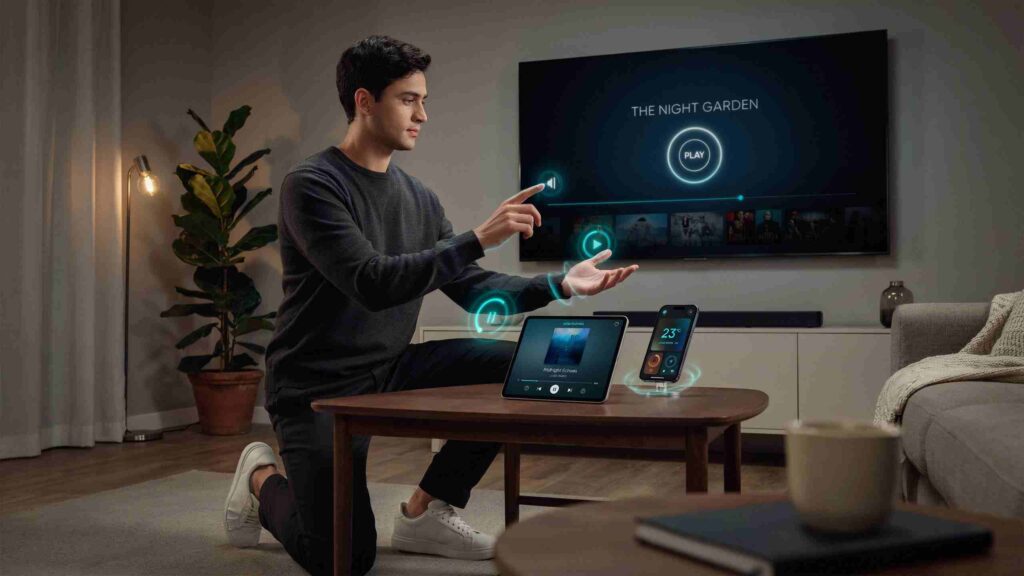
Imagine controlling your phone, car, TV, or medical device without touching a single button. In a world where screens, switches, and keyboards often slow users down, people need faster, safer, and more natural ways to interact with technology. This is where gesture recognition technology becomes important. It allows machines to understand human movements, such as hand signs, finger motions, body gestures, and facial expressions, and convert them into digital commands.
From touchless healthcare systems to smart homes, gaming, vehicles, and virtual reality, this technology is reshaping human-machine interaction. In this article, you will learn how gesture recognition technology works, its key types, benefits, challenges, applications, and why it is becoming the future of touchless control.
What Is Gesture Recognition Technology?
Gesture recognition technology is a computer-based method that identifies and interprets human gestures. These gestures may include hand movements, finger positions, facial expressions, body posture, arm motion, head movement, or full-body activity. The main goal is to convert human movement into a command that a machine can understand.
For example, when a user swipes their hand in the air to move to the next slide in a presentation, the system detects the movement, analyzes it, recognizes the gesture, and performs the command. Similarly, in virtual reality, a user may grab, rotate, or move a digital object using hand gestures. In healthcare, doctors may use touchless gestures to zoom in on medical scans during surgery.
Gesture recognition can be divided into two broad categories: touch-based gesture recognition and touchless gesture recognition. Touch-based recognition includes gestures performed on touchscreens, such as tapping, scrolling, pinching, and swiping. Touchless recognition uses cameras, sensors, radar, infrared systems, or wearable devices to detect gestures without physical contact.
The touchless form is becoming especially popular because it supports hygienic, convenient, and natural interaction. This is useful in hospitals, public places, kitchens, vehicles, and industrial settings where touching a surface may not be safe or practical.
How Gesture Recognition Technology Works
Gesture recognition technology works through a sequence of technical steps. The system first captures the movement, then processes the data, extracts useful features, classifies the gesture, and finally performs an action.
The first step is data capture. A system may use cameras, depth sensors, infrared sensors, radar sensors, accelerometers, gyroscopes, wearable bands, or electromyography sensors. Cameras capture visual movement. Depth sensors measure distance and 3D position. Wearable sensors record acceleration, rotation, and orientation. Electromyography sensors detect muscle signals.
The second step is pre-processing. Raw data collected from sensors is often noisy or incomplete. The system cleans the data, removes background interference, improves image quality, and separates the human hand or body from the environment. In camera-based systems, this may include detecting skin regions, hand contours, body skeletons, or facial landmarks.
The third step is feature extraction. The system identifies important details from the gesture, such as hand shape, finger position, movement direction, speed, distance, angle, duration, and body posture. These features help the system understand what type of gesture is being performed.
The fourth step is gesture classification. Machine learning or deep learning models compare the extracted features with trained gesture patterns. The system decides whether the gesture means “stop,” “select,” “swipe,” “zoom,” “rotate,” “move forward,” or another command.
The final step is system response. Once the gesture is recognized, the device performs the required function. For example, it may open an app, control a robot, pause a video, answer a call, scroll a screen, or move a virtual object.
Main Types of Gesture Recognition Technology
1. Vision-Based Gesture Recognition
Vision-based gesture recognition uses cameras to capture and analyze human movement. A normal camera can detect 2D movement, while a depth camera can detect 3D motion and distance. Computer vision algorithms then identify the hand, face, body, or object movement.
This type is widely used in gaming systems, smart TVs, virtual reality platforms, robotics, security cameras, and interactive displays. The main advantage is that users do not need to wear any device. They can interact naturally in front of a camera.
However, vision-based systems can face problems in poor lighting, complex backgrounds, crowded environments, or when the hand is hidden from the camera. For example, if a user performs a gesture in a dark room or behind another object, the system may fail to detect it correctly. Machines, tragically, still struggle when humans do normal human things like standing in inconvenient lighting.
2. Sensor-Based Gesture Recognition
Sensor-based gesture recognition uses physical sensors to track motion. These sensors may include accelerometers, gyroscopes, magnetometers, pressure sensors, or wearable motion detectors. Smartwatches, fitness bands, gaming controllers, and smart gloves often use this method.
This type is usually accurate because the sensors directly measure movement, rotation, and acceleration. For example, a smartwatch can detect wrist gestures, while a smart glove can identify finger bending and hand posture.
The main limitation is that the user must wear or hold a device. This may reduce comfort and natural interaction. However, sensor-based systems are still very useful in healthcare, sports, rehabilitation, gaming, and industrial control.
3. Touch-Based Gesture Recognition
Touch-based gesture recognition is the most common type used in smartphones, tablets, laptops, ATMs, and touchscreens. Common gestures include tapping, double-tapping, dragging, swiping, pinching, rotating, and long pressing.
This technology is easy to use because most people are already familiar with touchscreen gestures. It is also highly accurate because the system directly detects finger contact.
However, touch-based systems require physical contact. This makes them less suitable in sterile environments, public kiosks, medical operating rooms, and situations where the user’s hands are occupied, dirty, or wet.
4. Radar-Based Gesture Recognition
Radar-based gesture recognition uses radio waves to detect movement. These systems send signals and analyze how they bounce back from the user’s hand or body. Radar can detect small movements and may work even in darkness.
One major advantage of radar-based systems is privacy. Unlike cameras, radar does not capture detailed images of the user’s face or surroundings. It only detects motion patterns. This makes it useful for smart devices, automotive systems, and privacy-sensitive applications.
Radar-based recognition can also detect gestures in compact spaces, making it suitable for small electronic devices. However, it still requires advanced signal processing and careful calibration.
5. Electromyography-Based Gesture Recognition
Electromyography-based gesture recognition uses muscle activity to detect gestures. When a person moves or prepares to move, muscles produce electrical signals. EMG sensors capture these signals and convert them into gesture commands.
This method is important in prosthetic control, rehabilitation, assistive technology, and human-robot interaction. For example, a person with an artificial limb may control the prosthetic hand using muscle signals from the remaining limb.
The advantage of EMG is that it can detect intention before visible movement occurs. The limitation is that it usually requires wearable sensors or electrodes, which may not be comfortable for every user.
Role of Artificial Intelligence in Gesture Recognition Technology
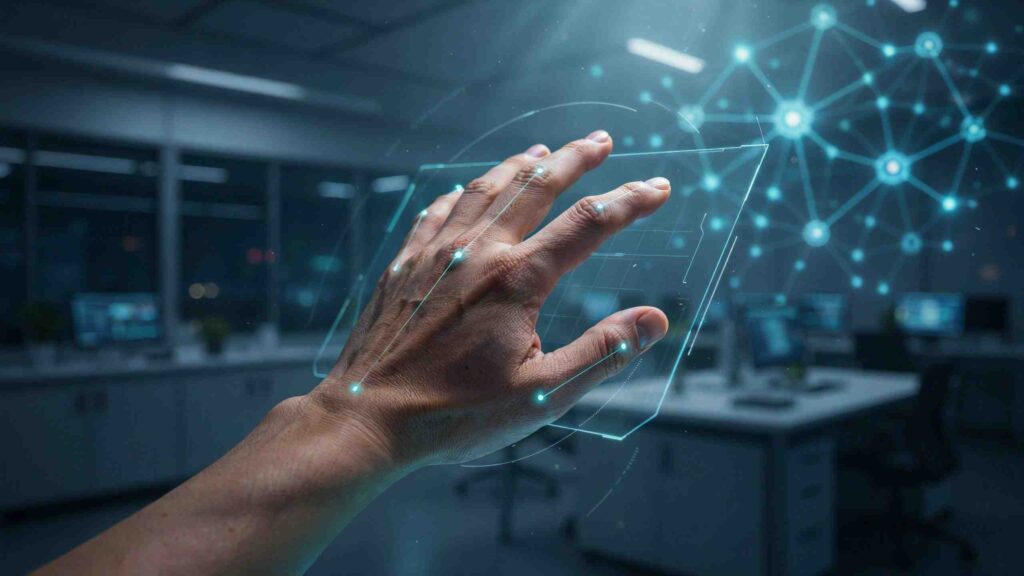
Artificial intelligence is one of the strongest drivers behind modern gesture recognition technology. Older systems depended on fixed rules. Developers had to manually define each gesture, and the system could only recognize gestures performed in a very specific way. If the user moved slightly differently, the system could fail.
AI-based systems are more flexible. They can learn from examples and recognize variations in gestures. Machine learning models can be trained using large datasets containing different hand shapes, movement speeds, angles, lighting conditions, and body positions.
Deep learning has made gesture recognition even more powerful. Convolutional neural networks are commonly used for image and video-based gesture recognition. Recurrent neural networks and long short-term memory models are useful for analyzing gesture sequences over time. More advanced models can combine visual, spatial, and temporal information to improve accuracy.
AI also helps distinguish between intentional gestures and random movements. This is very important because not every hand movement is a command. A person may scratch their head, move their hand while talking, or adjust their clothes. A good gesture recognition system must avoid treating every random movement like an instruction from the gods.
Applications of Gesture Recognition Technology
1. Smartphones and Consumer Electronics
Gesture recognition is already common in smartphones and consumer electronics. Touch gestures such as swiping, pinching, tapping, and scrolling are basic examples. Some advanced devices also support air gestures, allowing users to control functions without touching the screen.
Smart TVs use gesture recognition for volume control, channel selection, menu navigation, and media playback. Laptops use touchpad gestures for scrolling, zooming, switching apps, and opening menus.
Consumer electronics benefit from gesture recognition because it makes devices easier and faster to control. Instead of searching through menus, users can perform simple movements.
2. Gesture Recognition Technology in Gaming and Entertainment
Gaming is one of the most popular fields for gesture recognition. Motion-based gaming systems allow players to control characters and actions using body movement. This creates a more active and immersive gaming experience.
In virtual reality and augmented reality, gesture recognition is even more important. Users can interact with digital environments using natural hand movements. They can pick up virtual objects, throw items, draw shapes, press virtual buttons, and manipulate 3D models.
Entertainment systems also use gesture recognition for interactive displays, digital art, music control, and immersive experiences. It makes digital entertainment feel more physical and engaging.
3. Gesture Recognition Technology in Healthcare Systems
Healthcare is one of the most valuable areas for gesture recognition technology. In operating rooms, surgeons may need to view medical images, CT scans, MRI scans, or patient records without touching a computer. Touchless gesture control allows them to navigate images while maintaining sterility.
Gesture recognition is also useful in rehabilitation. Patients recovering from stroke, injury, surgery, or neurological disorders can perform guided exercises while the system tracks their movements. The system can measure range of motion, speed, coordination, and exercise accuracy.
Assistive technologies also benefit from gesture recognition. People with disabilities may use gestures to control wheelchairs, computers, prosthetic limbs, smart home devices, or communication systems. This can improve independence and quality of life.
4. Gesture Recognition Technology in Automotive Systems
Modern vehicles are increasingly using gesture recognition to improve driver interaction. Drivers may use hand gestures to adjust volume, answer calls, control navigation, reject notifications, or manage infotainment systems.
The main goal is to reduce distraction. Instead of looking down at a touchscreen, drivers can use simple gestures while keeping attention on the road. However, the system must be highly accurate. A false gesture inside a vehicle can be irritating or unsafe. Cars already contain enough buttons, menus, and mysterious warning lights. They do not need extra confusion from poorly designed gesture controls.
5. Gesture Recognition Technology in Smart Homes
Gesture recognition technology can make smart homes more convenient. Users may control lights, fans, speakers, curtains, thermostats, doors, and appliances using simple gestures.
For example, a person could raise a hand to turn on lights, wave to close curtains, or point toward a device to activate it. This is useful when hands are wet, dirty, full, or when voice commands are not suitable.
Smart home gesture systems can also help elderly people and individuals with mobility limitations. Instead of moving around the house to control devices, they can use gestures from a comfortable position.
6. Robotics and Industrial Automation
Gesture recognition is useful in robotics because it allows humans to control machines naturally. Instead of writing complex commands, workers can guide robots with hand signals.
In industrial environments, gesture control may improve safety by allowing workers to operate machines from a distance. It can also support collaborative robots that work near humans in factories, warehouses, laboratories, and manufacturing plants.
For example, a worker may use gestures to stop a robot, move it to a position, control lifting equipment, or guide automated systems. This can improve workflow efficiency and reduce physical contact with dangerous machinery.
7. Gesture Recognition Technology in Education and Training
Gesture recognition can improve digital education and professional training. Teachers can use gestures to control presentations, smart boards, simulations, and virtual classrooms.
In technical training, gesture-based systems can create realistic simulations. Medical students can practice surgery in virtual environments. Engineers can manipulate 3D models. Pilots can train using gesture-supported simulation systems. Students can interact with digital content instead of passively watching it.
This makes learning more active and practical. Naturally, it also gives students one more way to avoid reading, because apparently textbooks were too direct.
8. Gesture Recognition Technology in Security and Authentication
Gesture recognition can be used as a biometric security method. The way a person performs a gesture may be unique based on speed, rhythm, movement angle, and motion pattern.
Gesture-based authentication may be combined with fingerprints, facial recognition, voice recognition, or passwords to improve security. For example, a user may unlock a device by performing a specific hand movement.
However, security systems must protect against imitation, spoofing, and recorded movement attacks. Gesture recognition alone may not be strong enough for high-security systems, but it can be useful as part of multi-factor authentication.
Benefits of Gesture Recognition Technology
Gesture recognition technology offers many important benefits. The first benefit is natural interaction. Humans already use gestures in communication, so gesture-based systems can feel more intuitive than complex buttons and menus.
The second benefit is touchless control. This is useful in hospitals, laboratories, kitchens, public kiosks, vehicles, and industrial environments. Touchless systems reduce physical contact and may improve hygiene.
The third benefit is accessibility. Gesture recognition can help people with disabilities interact with digital systems, wheelchairs, prosthetics, and smart devices. This makes technology more inclusive.
The fourth benefit is speed and convenience. Some gestures are faster than typing, clicking, or navigating through menus. A simple hand movement can perform a command instantly.
The fifth benefit is better immersion. In gaming, virtual reality, and augmented reality, gesture recognition allows users to interact with digital objects naturally.
The sixth benefit is safety. In vehicles and factories, gesture control can reduce the need to touch controls or move close to dangerous equipment.
Challenges of Gesture Recognition Technology
Although gesture recognition technology is powerful, it still faces several challenges. One major challenge is accuracy. Human gestures vary between users. The same gesture may be performed differently depending on age, hand size, culture, physical ability, speed, and personal habit.
Another challenge is environmental conditions. Camera-based systems may fail in low light, bright sunlight, shadows, or crowded backgrounds. Sensor-based systems may suffer from calibration issues, battery limitations, or signal noise.
A third challenge is gesture ambiguity. A movement may be intentional or accidental. The system must understand context. Otherwise, a normal hand movement could accidentally trigger a command.
Privacy is also a serious issue. Vision-based systems may capture images or videos of users. This raises concerns about surveillance, consent, data storage, and misuse. Developers must design systems with privacy protection, secure processing, and transparent policies.
Another challenge is user fatigue. Repeated mid-air gestures can become tiring, especially if they require large arm movements. Good gesture design should use simple, comfortable, and low-effort movements.
Finally, there is a lack of universal standards. Different devices may use different gestures for the same action. This can confuse users and reduce adoption.
Gesture Recognition Technology and Sign Language
Gesture recognition technology has great potential in sign language recognition. These systems aim to translate sign language into text or speech, helping communication between deaf or hard-of-hearing individuals and people who do not understand sign language.
However, sign language recognition is technically difficult. Sign language is not just a collection of hand signs. It includes grammar, facial expressions, hand shape, body posture, movement direction, location, and timing.
Recognizing single signs is easier than understanding continuous sign language sentences. Real-time translation requires advanced AI models, large datasets, and cultural understanding. Different regions may also use different sign languages, which makes development more complex.
Still, this area has strong future potential. With better datasets, improved computer vision, and inclusive design, gesture recognition could support more accessible communication tools.
Gesture Recognition in Virtual Reality and Augmented Reality
Virtual reality and augmented reality depend heavily on gesture recognition. In VR, users interact inside a fully digital environment. In AR, digital objects are placed over the real world. Both systems require natural interaction.
Gesture recognition allows users to grab, move, resize, rotate, and control virtual objects with their hands. This creates a more realistic experience compared with traditional controllers.
In healthcare, doctors can use AR gestures to view anatomical models. In engineering, designers can manipulate 3D product models. Education enables students to interact with virtual objects. Architecture allows users to explore digital building models.
As spatial computing grows, gesture recognition will become even more important. Future systems may combine hand gestures, eye tracking, voice commands, and body movement for more advanced interaction.
Gesture Recognition and Human-Computer Interaction
Human-computer interaction focuses on how people use digital systems. Gesture recognition is important because it expands interaction beyond keyboards, mice, and touchscreens.
A well-designed gesture system should be simple, accurate, comfortable, and easy to learn. Users should not need to memorize complicated movements. Gestures should match natural human behavior.
For example, swiping left to move backward, pinching to zoom, or raising a hand to stop are intuitive gestures. Complex gestures with no clear meaning can confuse users.
Good gesture-based interfaces should also provide feedback. The system should show whether a gesture was detected and what action was performed. Without feedback, users may repeat gestures unnecessarily and begin performing a tragic little dance for an unresponsive machine.
Future of Gesture Recognition Technology
The future of gesture recognition technology is linked with artificial intelligence, smart devices, robotics, wearable systems, augmented reality, virtual reality, and the Internet of Things. As sensors become smaller and AI models become more powerful, gesture recognition will become more common in daily life.
Future systems will likely use multimodal interaction, combining gestures with voice, facial expressions, eye movement, and touch. This will help machines understand user intent more accurately.
Smart homes may use gestures for personalized control. Cars may use gestures for safer infotainment systems. Hospitals may use touchless systems for sterile workflows. Factories may use gesture-controlled robots. Classrooms may use gesture-based interactive learning.
The best future systems will be those that work quietly in the background. Users should not feel like they are controlling a machine through complicated commands. They should feel like the system understands natural movement.
Privacy and Ethical Issues in Gesture Recognition Technology
As gesture recognition technology becomes more advanced, ethical concerns must be addressed. Systems that capture body movement, facial expressions, and behavioral patterns may collect sensitive personal data.
Companies must clearly explain what data is collected, how it is stored, and whether it is shared. Local processing, encryption, anonymization, and user consent should be prioritized.
Bias is another concern. If a system is trained on limited datasets, it may not work equally well for all users. Differences in skin tone, hand shape, body type, age, disability, and cultural gestures can affect performance.
Developers must use diverse datasets and test systems across different populations. Gesture recognition should be inclusive, not designed only for a narrow group of users.
Users should also have alternative control options. Gesture recognition should improve interaction, not force everyone to use gestures in every situation.
Final Thoughts
Gesture recognition technology is transforming human-machine interaction by making digital systems more natural, touchless, intelligent, and accessible. It allows people to control devices through hand movements, body gestures, facial expressions, and physical actions. From smartphones and smart TVs to healthcare, vehicles, robotics, gaming, and virtual reality, this technology is already becoming part of everyday life.
However, gesture recognition technology must continue improving before it becomes fully reliable everywhere. Accuracy, privacy, user fatigue, cultural differences, environmental limitations, and ethical concerns are still important challenges. Developers must design systems that are simple, secure, inclusive, and practical for real users.
In the future, gesture recognition will likely become a key part of smart environments and advanced human-computer interaction. When combined with artificial intelligence, wearable sensors, computer vision, and spatial computing, it can create more responsive and personalized digital experiences. If developed responsibly, gesture recognition technology can make machines easier to use, improve accessibility, support safer workplaces, and create more natural communication between humans and digital systems.
FAQs About Gesture Recognition Technology
1. What is gesture recognition technology?
Gesture recognition technology allows machines to understand human movements and convert them into digital commands.
2. How does gesture recognition technology work?
It works by using cameras, sensors, radar, or AI systems to detect, analyze, and respond to human gestures.
3. Why is gesture recognition technology important?
It makes human-machine interaction faster, safer, touchless, and more natural for users.
4. What are the main types of gesture recognition technology?
The main types include vision-based, sensor-based, touch-based, radar-based, and electromyography-based gesture recognition.
5. What is touchless gesture recognition?
Touchless gesture recognition allows users to control devices without physically touching screens, buttons, or switches.
6. Where is gesture recognition technology used?
It is used in smartphones, smart TVs, healthcare, gaming, vehicles, smart homes, robotics, and virtual reality.
7. How is gesture recognition technology used in healthcare?
In healthcare, it helps doctors control medical images, support rehabilitation, and use devices without touching screens.
8. How does AI improve gesture recognition technology?
AI helps systems learn gesture patterns, recognize movement variations, and improve accuracy in real-world use.
9. What is vision-based gesture recognition?
Vision-based gesture recognition uses cameras to detect and analyze hand movements, facial expressions, or body gestures.
10. What is sensor-based gesture recognition?
Sensor-based gesture recognition uses wearable sensors, accelerometers, or gyroscopes to track body or hand movement.
11. What is radar-based gesture recognition?
Radar-based gesture recognition uses radio waves to detect human movement without capturing detailed visual images.
12. What are the benefits of gesture recognition technology?
Its benefits include touchless control, better hygiene, faster device use, improved accessibility, and natural interaction.
13. What are the challenges of gesture recognition technology?
Common challenges include accuracy issues, poor lighting, accidental gestures, privacy risks, and user fatigue.
14. Can gesture recognition technology understand sign language?
Yes, it can recognize some sign language gestures, but full sign language translation is still technically complex.
15. How is gesture recognition technology used in smart homes?
It allows users to control lights, fans, speakers, curtains, and appliances using simple hand movements.
16. How is gesture recognition technology used in cars?
In cars, it helps drivers control volume, calls, navigation, and infotainment systems through hand gestures.
17. Is gesture recognition technology safe?
Yes, it can be safe if systems protect user data, avoid unnecessary recording, and use secure processing.
18. What privacy issues are linked with gesture recognition technology?
Privacy issues include video recording, movement tracking, data storage, user consent, and possible misuse of personal data.
19. What is the future of gesture recognition technology?
Its future includes smarter AI, better sensors, wider touchless control, and stronger use in smart devices and vehicles.
20. Why is gesture recognition technology called the future of touchless control?
It allows people to control machines naturally without touching screens, buttons, or physical devices.
Continue Reading
Technology News OTVPTech: Latest Trends You Must Know
The House of Technology: Future Digital World
What Technology Innovations Happened in California Recently and Why