
Introduction
When emergencies happen, every second can decide the difference between control and crisis. Today, cities and emergency teams face growing challenges, from cyber threats and natural disasters to crowded urban areas and delayed response systems. This is where public safety technology news becomes essential. It helps readers understand how AI, drones, smart alerts, command centers, cybersecurity tools, and advanced communication systems are changing the way communities stay protected. In this article, you will discover the latest trends saving lives today, how these technologies improve emergency response, and why responsible innovation is becoming a key part of modern public safety.
What Is Public Safety Technology?
Public safety technology refers to tools, systems, devices, and software used to protect people, property, infrastructure, and communities. It includes emergency call systems, public warning platforms, dispatch software, drones, artificial intelligence, digital evidence systems, surveillance tools, cybersecurity systems, smart city sensors, traffic monitoring tools, and communication networks.
The main goal of public safety technology is to help agencies respond faster and more effectively. For example, when someone calls emergency services, the system should quickly identify the location, understand the type of emergency, and send the correct response team. If police, firefighters, paramedics, and emergency managers can share information in real time, the response becomes smoother and safer.
Public safety technology also helps agencies prevent incidents before they become worse. Flood sensors can detect rising water levels. Traffic systems can identify accidents. Fire monitoring tools can detect smoke or heat. Cybersecurity systems can identify digital threats. These tools help agencies take action earlier instead of waiting until the situation becomes a full disaster, because apparently waiting for disaster is still humanity’s favorite planning method.
Why Public Safety Technology Is Growing
Public safety technology is growing because modern risks are growing. Cities are becoming more crowded, transport systems are busier, climate-related disasters are increasing, and cyber threats are becoming more serious. At the same time, the public expects emergency services to respond quickly and communicate clearly.
Another reason is the rise of smartphones and digital communication. People now expect to send texts, photos, videos, and live locations during emergencies. Traditional emergency systems were designed mainly for voice calls, but modern emergencies often need more than voice. A person trapped in a dangerous situation may not be able to speak, but they may be able to send a message or location.
Emergency agencies are also facing staff shortages and budget pressure. Technology can help reduce workload by automating reports, improving dispatch, organizing evidence, and supporting communication. This does not mean technology replaces humans. It means technology supports trained professionals so they can focus on urgent decisions.
However, technology must be selected carefully. Buying a tool just because it looks modern is not a strategy. Public safety systems must be reliable, secure, easy to use, and suitable for real emergency conditions.
Artificial Intelligence in Public Safety
Artificial intelligence is one of the biggest topics in public safety technology news. AI can analyze large amounts of data faster than humans can. It can help emergency agencies identify patterns, support dispatch decisions, review video footage, predict risks, and reduce paperwork.
In emergency dispatch centers, AI can help analyze calls, detect important keywords, transcribe conversations, and support decision-making. For example, if a caller is panicked or unable to explain clearly, AI tools may help identify background sounds, location clues, or emergency keywords. This can help dispatchers send the right help faster.
In policing, AI may assist with digital evidence review, video analysis, report writing, and crime pattern identification. In firefighting, AI can support wildfire prediction, smoke movement analysis, and building risk assessment. The application of AI in emergency medical services enhances triage decisions, ambulance routing efficiency, and coordination among healthcare facilities.
AI is useful, but it is not magic. It is software trained on data, and data can be incomplete, biased, or outdated. Trusting AI blindly in public safety would be like asking a calculator to raise your children. Technically confident, morally alarming.
Next Generation Emergency Communication
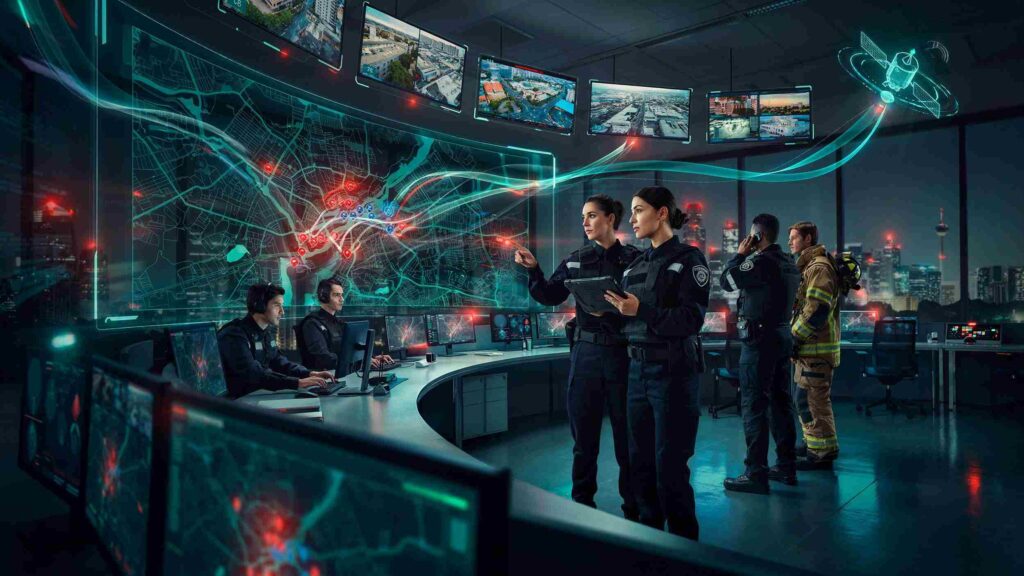
Emergency communication is changing quickly. Traditional emergency call systems were mainly designed for voice calls. Modern systems are moving toward digital platforms that can support voice, text, images, videos, and location data.
This type of modernization is important because people communicate differently now. During an emergency, a person may need to send a photo of an accident, a video of a fire, or their live location. Digital emergency communication can help dispatchers and responders understand the situation before they arrive.
Better emergency communication also improves coordination between different agencies. Police, firefighters, paramedics, hospitals, traffic departments, and disaster managers can share information more quickly. This is especially important during large emergencies such as floods, storms, wildfires, public events, or mass casualty incidents.
The main benefit is speed and clarity. If responders know the location, severity, and type of incident early, they can prepare properly. They can choose the best route, bring the right equipment, and avoid unnecessary delay.
However, digital communication also creates challenges. Emergency centers must manage more data, protect sensitive information, and train staff to handle new systems. More data is useful only when it is organized properly. Otherwise, it becomes a digital pile of confusion with a login screen.
Public Safety Broadband Networks
Reliable communication is essential for emergency response. First responders need strong and secure networks, especially during disasters when normal mobile networks may become overloaded. Public safety broadband networks are designed to give emergency workers better connectivity during critical situations.
These networks allow police officers, firefighters, paramedics, and emergency managers to share voice, video, maps, messages, and live updates. A firefighter may need building information before entering a burning structure. A paramedic may need to send patient details to a hospital. A police officer may need live updates from a command center. All of this requires reliable communication.
Public safety broadband also supports field devices such as tablets, body cameras, mobile data terminals, drones, and connected emergency vehicles. These tools help responders access information while they are on the move.
During disasters, communication failure can create serious problems. If teams cannot talk to each other, response becomes slow and unsafe. That is why strong public safety networks are becoming a major part of modern emergency planning.
Drones in Public Safety
Drones are now widely used in public safety because they can quickly provide aerial views of dangerous or difficult areas. They help responders understand a situation without immediately putting people at risk.
In firefighting, drones can detect hotspots, monitor fire spread, inspect roofs, and support wildfire control. In search and rescue, drones can scan forests, mountains, rivers, flood zones, and collapsed buildings. Drones provide valuable support for law enforcement activities, including missing person searches, traffic accident response, crowd monitoring, and high-risk incident management. They also play a critical role in disaster management by facilitating the assessment of damaged roads, bridges, buildings, and power transmission infrastructure.
However, drones also raise privacy concerns. Public safety agencies must have clear rules about when drones can be used, what they can record, how long footage is stored, and who can access it. People support safety, but they do not want random flying cameras hovering over their lives like nosy mechanical pigeons.
Smart Sensors and Smart City Safety
Smart city technology is becoming an important part of public safety. Cities are using sensors, cameras, connected traffic lights, environmental monitors, and digital platforms to detect risks and improve response.
Flood sensors can warn officials when water levels rise. Air quality sensors can detect pollution or chemical hazards. Smart traffic lights can help emergency vehicles move faster. Streetlight sensors can improve visibility and support public safety systems. Cameras and monitoring tools can help identify incidents in busy public areas.
These systems help cities respond earlier. Instead of waiting for multiple emergency calls, officials may receive automatic alerts from sensors. This can reduce response time and help prevent small problems from becoming major emergencies.
Smart city safety tools are especially useful in urban areas where many people, vehicles, and buildings are close together. A delay in one part of the city can quickly affect many others. Smart systems help officials see the larger picture.
But these systems must be secure and responsibly managed. Connected devices can be hacked if they are poorly protected. Also, too much monitoring can create privacy concerns. Cities need strong rules to make sure technology protects people without turning daily life into a surveillance experiment.
Public Alert and Warning Systems
Public alert and warning systems are essential during emergencies. These systems warn people about severe weather, floods, wildfires, chemical spills, evacuation orders, missing persons, active threats, and other dangers.
A good emergency alert should be clear, fast, and useful. People should know what happened, where it happened, what they should do, and where they can get more information. A confusing alert can create panic or cause people to ignore the warning.
Modern alert systems can send messages through mobile phones, radio, television, sirens, websites, apps, and digital signs. Some systems can target specific geographic areas, so only people in affected locations receive the warning. This reduces unnecessary panic and makes alerts more useful.
Emergency alerts must also be accessible. They should support people with disabilities, older adults, visitors, and people who speak different languages. During a crisis, unclear communication can put vulnerable groups at higher risk.
Alert fatigue is another issue. If people receive too many unnecessary alerts, they may stop paying attention. Public safety agencies must make sure alerts are accurate, timely, and relevant.
Real-Time Command Centers
Real-time command centers are becoming important in public safety operations. These centers collect information from emergency calls, cameras, field units, sensors, weather updates, dispatch systems, and public reports. The goal is to give decision-makers a complete view of an incident.
During a major emergency, command centers help agencies track responders, monitor resources, identify risks, and coordinate action. For example, during a large public event, a command center may monitor crowd movement, traffic, medical emergencies, weather conditions, and security concerns.
Real-time command centers improve cooperation between police, fire services, emergency medical teams, transportation departments, and disaster managers. Instead of working separately, agencies can share the same information and respond together.
The main advantage is coordination. Complex emergencies often involve multiple teams. Without shared information, agencies may duplicate efforts or miss important details. Command centers help reduce confusion.
However, these systems also collect sensitive data. Agencies must control who can access information and how it is used. Public safety should improve protection, not become an excuse for unlimited data collection.
Body Cameras and Digital Evidence
Body-worn cameras are now common in many law enforcement agencies. They help record interactions between officers and the public, support investigations, improve accountability, and provide evidence in legal cases.
Body cameras can protect both officers and citizens by creating a clearer record of what happened. However, they also create large amounts of video data. Agencies need secure systems to store, manage, search, redact, and share this evidence.
Digital evidence management systems help organize videos, photos, audio recordings, documents, and other case materials. These systems track who accessed evidence, when it was accessed, and how it was used. This helps protect the chain of custody.
Privacy is a major issue with body cameras. They may record victims, children, private homes, medical emergencies, or sensitive conversations. Agencies must balance transparency with dignity and legal protection.
Body cameras are useful, but they are not a complete solution by themselves. Accountability also requires good policies, training, supervision, and public trust.
Cybersecurity in Public Safety
Cybersecurity is now a major part of public safety. Emergency services depend on digital systems, including dispatch software, communication networks, databases, alert platforms, and command centers. If these systems are attacked, emergency response can be disrupted.
Cyberattacks can include ransomware, data theft, phishing, malware, and network shutdowns. A cyberattack on a public safety agency can delay calls, block access to records, expose sensitive data, and weaken public trust.
Public safety agencies need strong cybersecurity practices. These include secure passwords, multi-factor authentication, regular software updates, staff training, backup systems, network monitoring, and incident response plans.
Cybersecurity must be planned from the beginning. It should not be added after a system is already built. That is like building a fire station out of paper and then wondering why the flames seem personally interesting.
Small agencies may struggle with cybersecurity because of limited budgets and staff. Regional cooperation, shared services, and government support can help smaller communities improve protection.
Predictive Analytics and Risk Forecasting
Predictive analytics uses data to estimate where risks may happen in the future. In public safety, it can help identify areas with higher chances of traffic accidents, fires, emergency medical calls, flooding, or infrastructure failure.
Emergency medical services can use predictive tools to position ambulances in areas where calls are more likely. Fire departments can identify buildings that may need inspection. Disaster teams can use risk models to prepare evacuation routes before storms or floods.
The benefit of predictive analytics is preparation. Instead of only reacting after something happens, agencies can plan ahead and place resources where they may be needed most.
However, predictive analytics must be used carefully. Historical data can include bias or gaps. If a system is trained on unfair or incomplete data, it may produce unfair results. Public safety agencies must review these tools regularly and avoid treating predictions as guaranteed truth.
Predictive analytics should support planning, not replace human judgment. Data can show patterns, but trained professionals must interpret those patterns with real-world understanding.
Emergency Medical Technology
Emergency medical services are also improving through technology. Ambulances now use GPS routing, digital patient records, mobile communication, and hospital coordination systems. These tools help paramedics provide faster and better care.
Paramedics can send patient information to hospitals before arrival. This allows emergency departments to prepare equipment, staff, and treatment plans. In serious cases, this can save valuable time.
Telemedicine tools can also support emergency care. Paramedics may consult doctors remotely during complex cases. This is especially useful in rural areas where hospitals may be far away.
Wearable health devices may also play a role in public safety. Some devices can detect falls, heart rhythm problems, or emergency health events. When connected to alert systems, they may help people get assistance faster.
Future emergency medical technology may include AI-supported triage, drone delivery of medical supplies, improved ambulance routing, and better hospital coordination.
Robotics in Public Safety
Robots are increasingly used in dangerous public safety situations. Bomb disposal robots are already used by many agencies. Firefighting robots can enter areas that are too dangerous for humans. Search and rescue robots can inspect collapsed buildings, tunnels, or hazardous spaces.
Robots can carry cameras, sensors, communication tools, and equipment. They can help responders evaluate risks before entering dangerous scenes.
In chemical spills, fires, industrial accidents, and disaster zones, robots can reduce human exposure to danger. They do not replace responders, but they support them by handling high-risk tasks.
As robotics improves, public safety agencies may use more ground robots, water rescue robots, indoor inspection robots, and disaster response robots. These tools can make emergency operations safer and more effective.
Benefits of Public Safety Technology
The first major benefit of public safety technology is faster response. Better communication, GPS tracking, digital dispatch, and real-time alerts help agencies reach emergencies more quickly.
The second benefit is better situational awareness. Responders can receive live updates, maps, videos, images, and sensor data. This helps them understand the emergency before they arrive.
The third benefit is responder safety. Drones, robots, cameras, and sensors can help agencies assess danger before sending people into risky areas.
The fourth benefit is improved public communication. Alert systems and emergency apps can warn people quickly and clearly. During disasters, good communication reduces panic and helps people make safer decisions.
The fifth benefit is accountability. Body cameras, digital records, evidence systems, and audit logs help document actions and improve transparency.
Challenges of Public Safety Technology
Public safety technology also has challenges. Cost is one of the biggest. Advanced systems can be expensive to buy, maintain, update, and secure. Smaller agencies may not have enough resources.
Training is another challenge. Technology is useful only if people know how to use it properly. Emergency workers must be trained to operate systems during stressful situations.
Privacy is also a serious concern. Drones, cameras, sensors, and AI tools can collect sensitive information. Agencies must create clear rules to protect people’s rights.
Cybersecurity is another major risk. More connected systems mean more opportunities for hackers. Public safety agencies must protect their networks and data.
Bias is also important. AI and predictive systems can produce unfair results if they use biased data. Agencies must test and monitor these tools carefully.
The Future of Public Safety Technology
The future of public safety technology will focus on integration, speed, security, and responsible innovation. Agencies will need systems that connect emergency calls, dispatch, field units, hospitals, traffic control, public alerts, and command centers.
Artificial intelligence will continue to grow, but human oversight will remain essential. AI can help analyze data and reduce workload, but it should not make final life-changing decisions without human review.
Drones and robotics will become more common. They will help responders inspect dangerous areas, search for missing people, deliver supplies, and monitor disasters.
Public alerts will become smarter and more targeted. Future systems may send personalized warnings based on location, language, accessibility needs, and type of emergency.
The best public safety technology will not be the most expensive or flashy. It will be the technology that works reliably when lives are at risk.
How Agencies Can Use Public Safety Technology Responsibly
Public safety agencies should start by identifying real problems. Technology should be selected to solve specific needs, not because it is trendy. Agencies should ask whether a system improves response time, safety, communication, accountability, or public trust.
Frontline workers should be involved in technology decisions. Dispatchers, police officers, firefighters, paramedics, emergency managers, IT teams, and community leaders should help evaluate tools.
Clear policies are necessary. Agencies must define how technology is used, who can access data, how long information is stored, and how mistakes are reviewed.
Regular testing and evaluation are also important. Technology must be updated, audited, and improved. A system that worked well years ago may no longer be effective or secure.
Most importantly, public safety technology should support people. It should help responders do their jobs better and help communities stay safer.
Final Thoughts
Public safety technology news shows how modern tools are changing the way communities prepare for, respond to, and recover from emergencies. From artificial intelligence and drones to smart sensors, emergency alerts, broadband networks, body cameras, command centers, cybersecurity systems, and robotics, these technologies are helping emergency agencies act faster and make better decisions. Their biggest value is not only speed, but also the ability to give first responders clearer information when every second matters.
However, public safety technology must be used responsibly. Powerful tools can improve emergency response, but they also bring challenges such as privacy risks, cybersecurity threats, high costs, poor training, and possible bias in automated systems. For this reason, agencies must choose reliable systems, train their teams properly, protect public data, and keep human judgment at the center of every important decision.
The future of public safety will depend on smart balance. Technology should not replace emergency workers; it should support them. When used with clear policies, strong security, and public trust, modern safety tools can help build safer cities, stronger emergency systems, and better protection for communities. That is why following public safety technology news is important for understanding the trends saving lives today and shaping safer communities for tomorrow.
FAQs about public safety technology news
1. What is public safety technology?
Public safety technology includes tools like AI, drones, emergency alerts, smart sensors, body cameras, and communication systems that help protect people and improve emergency response.
2. Why is public safety technology important?
Public safety technology is important because it helps emergency teams respond faster, share information clearly, and make better decisions during dangerous situations.
3. What does public safety technology news cover?
Public safety technology news covers the latest updates about AI, drones, smart alerts, cybersecurity, emergency communication, and other tools improving public safety.
4. How does AI help in public safety?
AI helps public safety teams analyze data, detect risks, support emergency dispatch, review video footage, and reduce paperwork for faster response.
5. How are drones used in public safety?
Drones are used for firefighting, search and rescue, disaster assessment, traffic accidents, missing person searches, and dangerous scene inspection.
6. What are public alert systems?
Public alert systems send emergency warnings through phones, sirens, radio, television, apps, and digital platforms during threats like floods, storms, or fires.
7. Why are smart sensors useful for public safety?
Smart sensors can detect risks like rising floodwater, smoke, traffic accidents, poor air quality, or other hazards before they become bigger emergencies.
8. What is the role of cybersecurity in public safety?
Cybersecurity protects emergency systems, communication networks, databases, and alert platforms from hacking, ransomware, and data theft.
9. Can public safety technology replace emergency workers?
No, public safety technology cannot replace emergency workers. It only supports police, firefighters, paramedics, and emergency teams with better tools and information.
10. What are the main benefits of public safety technology?
The main benefits include faster response, better communication, improved safety, stronger public alerts, better planning, and more effective emergency management.
11. What challenges come with public safety technology?
Common challenges include high costs, privacy concerns, cybersecurity risks, poor training, false alerts, AI bias, and overdependence on automated systems.
12. Why should public safety technology be used responsibly?
It should be used responsibly because these tools affect privacy, public trust, emergency decisions, and community safety. Human oversight is always important.
Continue Reading
Gaming News Etruesports: Big Updates Gamers Should Know
Gesture Recognition Technology: The Future of Touchless Control
Technology News OTVPTech: Latest Trends You Must Know