
Introduction
Looking to build a successful career in fintech but unsure where to start? With so much information available, it can be difficult to understand what a financial recovery technologies software engineer actually does, which skills employers expect, and whether the role offers strong career growth. This guide removes the confusion by providing a complete overview of the profession, from job responsibilities and technical skills to salary expectations, certifications, career opportunities, and future trends.
Whether you’re a student, an aspiring developer, or an experienced software engineer exploring the fintech industry, you’ll discover everything you need to know about becoming a financial recovery technologies software engineer and preparing for long-term success in this fast-growing field.
What Are Financial Recovery Technologies?
Financial Recovery Technologies (FRT) is a financial technology company that provides software solutions designed to help institutional investors recover financial losses resulting from securities class action settlements and other legal claims. Instead of manually tracking thousands of cases across different jurisdictions, FRT automates the entire recovery process through intelligent software platforms.
The company combines technology with financial expertise to identify eligible claims, monitor legal developments, organize documentation, and maximize financial recoveries for investment firms around the world.
Unlike traditional software companies that develop general business applications, Financial Recovery Technologies focuses on highly specialized financial software where security, compliance, scalability, and accuracy are essential.
Why Software Engineers Are Important at Financial Recovery Technologies
Software engineers are responsible for transforming complicated financial processes into intelligent digital systems. Every platform used by institutional investors depends on engineers who can design reliable software capable of handling sensitive financial information.
Their work includes building secure applications, optimizing databases, integrating APIs, improving performance, fixing bugs, and implementing new features that improve operational efficiency. Without software engineers, automation within financial recovery would not be possible.
As financial regulations continue evolving, software engineers also ensure applications remain compliant with industry standards while maintaining excellent performance and security.
Key Responsibilities of a Financial Recovery Technologies Software Engineer
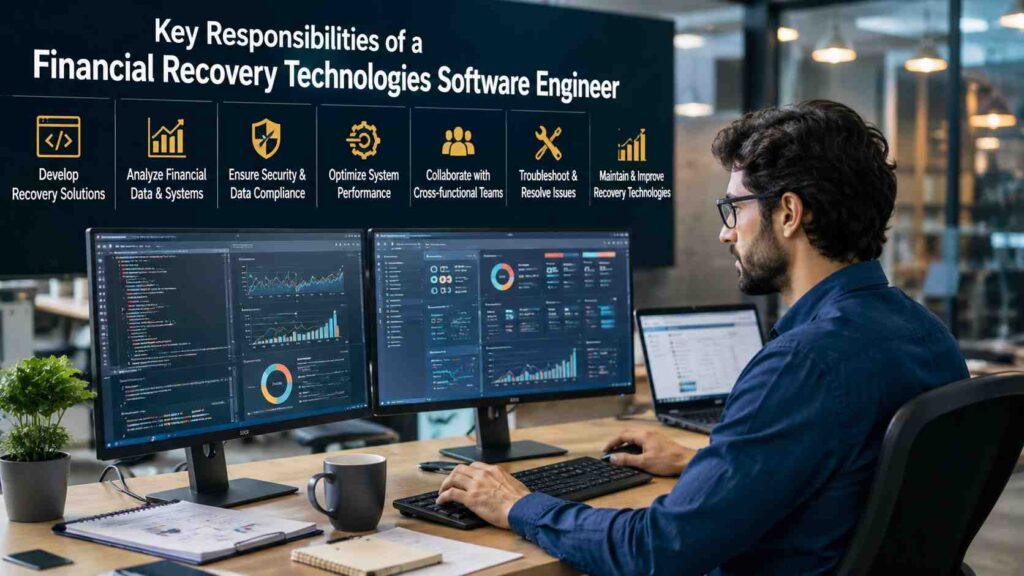
A financial recovery technologies software engineer performs several technical and collaborative responsibilities throughout the software development lifecycle.
Software Development
Software engineers design, develop, test, and deploy enterprise applications that automate investment recovery processes. They write clean, maintainable, and scalable code while following software engineering best practices.
Application Maintenance
Existing systems require continuous updates, bug fixes, security improvements, and performance enhancements. Engineers monitor application health and resolve issues before they affect users.
Database Development
Financial applications process enormous amounts of structured information. Engineers design database schemas, optimize SQL queries, improve indexing, and maintain data integrity.
API Integration
Enterprise financial systems often communicate with external platforms through secure APIs. Engineers develop and maintain REST APIs that ensure reliable communication between software systems.
Software Security
Protecting confidential financial information is a top priority. Software engineers implement authentication, authorization, encryption, secure coding standards, and vulnerability prevention techniques.
Performance Optimization
Large-scale financial software must remain responsive under heavy workloads. Engineers continuously improve system performance by optimizing application architecture, database queries, caching strategies, and server resources.
Technical Skills Required
Success as a financial recovery technologies software engineer requires strong technical expertise across multiple programming languages, frameworks, databases, and cloud technologies.
Programming Languages
Most engineers are expected to understand several modern programming languages, including:
- Java
- C#
- Python
- JavaScript
- TypeScript
- SQL
Each language serves different purposes, from backend services to frontend interfaces and database management.
Front-End Development
Modern financial software requires intuitive dashboards and responsive interfaces.
Common frontend technologies include:
- React
- Angular
- HTML5
- CSS3
- Bootstrap
These frameworks allow engineers to build clean, interactive user experiences.
Back-End Development
Backend systems manage business logic, financial calculations, security, and database communication.
Popular backend technologies include:
- .NET
- ASP.NET Core
- Spring Boot
- Node.js
These frameworks provide the reliability needed for enterprise financial applications.
Database Technologies
Database knowledge is one of the most valuable skills for any financial recovery technologies software engineer because financial applications rely heavily on structured information.
Microsoft SQL Server
Many enterprise financial systems use SQL Server because of its stability, reporting capabilities, and enterprise security.
PostgreSQL
PostgreSQL offers excellent scalability, reliability, and advanced SQL features suitable for fintech applications.
Oracle Database
Oracle remains a popular choice for large financial organizations requiring high-performance enterprise databases.
MySQL
MySQL is commonly used for internal tools, reporting applications, and supporting services.
Engineers should understand indexing, query optimization, normalization, stored procedures, transactions, and backup strategies.
Cloud Computing and Infrastructure
Cloud computing has transformed enterprise software development, and Financial Recovery Technologies software engineers increasingly work with cloud-native applications.
Microsoft Azure
Azure provides enterprise cloud infrastructure, AI services, storage solutions, and security tools suitable for financial applications.
Amazon Web Services (AWS)
AWS enables organizations to build scalable applications using cloud databases, serverless computing, monitoring, and storage services.
Docker
Docker allows developers to package applications into containers that run consistently across development, testing, and production environments.
Kubernetes
Kubernetes simplifies the deployment, scaling, monitoring, and management of containerized applications through automated orchestration.
Understanding cloud technologies enables engineers to build highly available, secure, and scalable financial software.
Software Development Methodologies
Modern fintech organizations rely on Agile software development to deliver features quickly while maintaining software quality.
Agile Development
Agile focuses on continuous improvement, teamwork, rapid software delivery, and customer feedback.
Benefits include:
- Faster releases
- Better collaboration
- Improved product quality
- Flexible project management
- Continuous innovation
Scrum Framework
Most development teams use Scrum, where projects are divided into short development cycles called sprints.
Daily stand-up meetings, sprint planning sessions, reviews, and retrospectives help teams maintain productivity and deliver software efficiently.
Essential Soft Skills
Technical knowledge alone is not enough to become a successful financial recovery technologies software engineer.
Employers also value professionals who possess strong interpersonal and analytical skills.
Problem-Solving
Software engineers regularly solve complex business and technical challenges involving financial calculations, data processing, and system architecture.
Communication
Clear communication improves collaboration between developers, testers, project managers, analysts, and business stakeholders.
Teamwork
Enterprise software development requires developers to work closely with multiple departments throughout the project lifecycle.
Time Management
Engineers must balance coding, meetings, testing, debugging, documentation, and project deadlines effectively.
Continuous Learning
Technology evolves rapidly. Successful engineers continually improve their knowledge of programming languages, cybersecurity, cloud computing, artificial intelligence, and software architecture.
A Typical Day of a Financial Recovery Technologies Software Engineer
A typical day often begins with a short Agile stand-up meeting where team members discuss completed work, ongoing tasks, and any challenges affecting development. After planning priorities, engineers spend most of their day writing code, reviewing pull requests, fixing bugs, or developing new application features.
Later in the day, developers collaborate with quality assurance engineers, database administrators, product managers, and business analysts to ensure software meets business requirements. Before ending the workday, they update documentation, commit code changes, review project progress, and prepare tasks for the next development sprint.
Salary Expectations for Financial Recovery Technologies Software Engineers
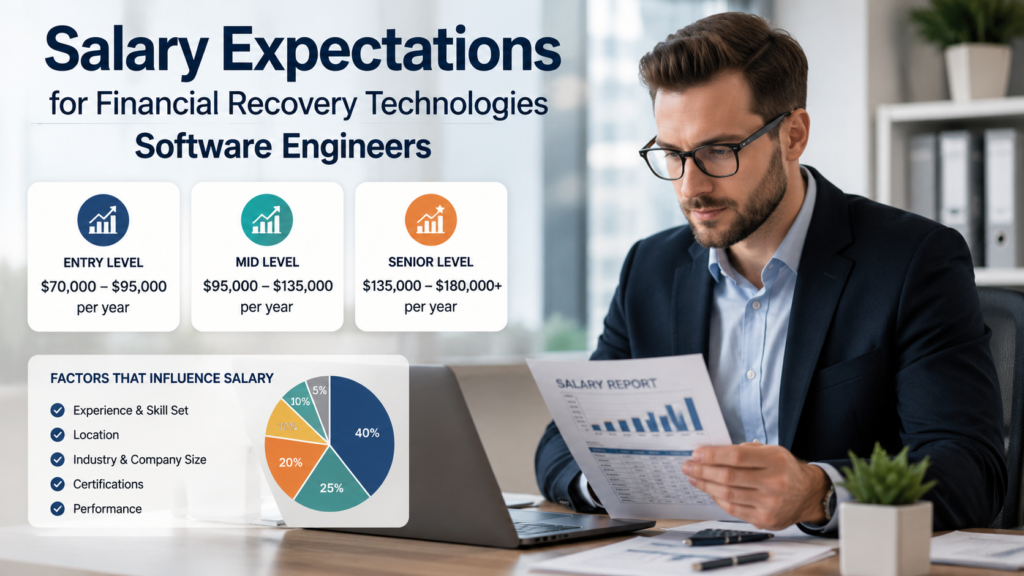
Salary is one of the biggest reasons professionals consider a career as a financial recovery technologies software engineer. Compensation varies depending on experience, technical expertise, education, and location. Engineers with strong programming skills and fintech experience generally earn higher salaries than entry-level developers.
Entry-Level Software Engineer
Graduates and junior developers usually begin by working on bug fixes, feature enhancements, testing support, and learning the company’s software architecture. This stage provides valuable hands-on experience with enterprise software development.
Mid-Level Software Engineer
After gaining several years of experience, engineers often take ownership of larger projects. They design application modules, mentor junior developers, improve system performance, and contribute to architectural decisions.
Senior Software Engineer
Senior engineers lead technical initiatives, review code, design scalable systems, solve complex engineering challenges, and collaborate with leadership teams on long-term software strategies.
Principal or Lead Engineer
At the highest technical level, engineers define software architecture, introduce new technologies, improve engineering standards, and guide multiple development teams across different projects.
Although salaries differ by region and company policies, software engineering remains one of the highest-paying careers in the fintech industry because of its technical complexity and business impact.
Educational Requirements
A career as a financial recovery technologies software engineer usually begins with a strong educational foundation. While some developers enter the field through self-learning or coding boot camps, most employers prefer candidates with formal technical education.
Common educational backgrounds include:
- Computer Science
- Software Engineering
- Information Technology
- Computer Engineering
- Information Systems
Many successful software engineers also strengthen their qualifications through professional certifications, online courses, and continuous technical training.
Certifications That Can Improve Your Career
Professional certifications demonstrate commitment to continuous learning and help engineers remain competitive in the job market.
Some valuable certifications include:
Microsoft Certified: Azure Developer Associate
Validates cloud development skills using Microsoft Azure.
AWS Certified Developer
Demonstrates expertise in developing and deploying applications on Amazon Web Services.
Oracle Java Certification
Confirms advanced Java programming knowledge for enterprise software development.
Microsoft SQL Server Certification
Strengthens database management and SQL optimization skills.
Certified Kubernetes Application Developer (CKAD)
Validates expertise in containerized application deployment and orchestration.
While certifications are not always mandatory, they can significantly strengthen a software engineer’s resume.
Career Growth Opportunities
One of the biggest advantages of becoming a financial recovery technologies software engineer is the excellent long-term career progression.
Software Architect
Experienced engineers often transition into software architecture, where they design scalable enterprise systems and establish development standards.
Engineering Manager
Developers with leadership skills may move into management roles responsible for supervising software teams, planning projects, and mentoring engineers.
DevOps Engineer
Some engineers specialize in cloud infrastructure, automation, CI/CD pipelines, and deployment processes.
Data Engineer
Financial software generates enormous datasets, creating opportunities for engineers interested in data pipelines and analytics.
Artificial Intelligence Engineer
As fintech companies increasingly adopt machine learning, software engineers can specialize in AI-powered financial automation.
These career paths provide opportunities for both technical specialization and leadership advancement.
Work Environment
The work environment for a financial recovery technologies software engineer is collaborative, fast-paced, and technology-driven.
Engineers typically work alongside:
- Product Managers
- Quality Assurance Engineers
- Business Analysts
- UX Designers
- Database Administrators
- DevOps Engineers
- Security Specialists
Most organizations encourage teamwork through Agile methodologies, regular sprint planning, code reviews, and collaborative problem-solving sessions.
Many software engineering positions also offer hybrid or remote work opportunities depending on company policies.
Challenges of the Role
Although software engineering offers excellent career prospects, it also presents several professional challenges.
Managing Complex Financial Systems
Financial software often contains sophisticated business rules that require careful analysis and accurate implementation.
Maintaining Data Security
Protecting sensitive financial information demands strict adherence to cybersecurity best practices.
Meeting Tight Deadlines
Software releases frequently operate under strict project schedules, requiring efficient planning and teamwork.
Keeping Up with Technology
Programming languages, frameworks, and cloud platforms evolve continuously, making ongoing learning essential.
Regulatory Compliance
Financial software must comply with changing legal and regulatory requirements, requiring engineers to adapt applications regularly.
Despite these challenges, many professionals find the role intellectually rewarding and professionally fulfilling.
Future of Financial Recovery Technologies Software Engineers
The future looks extremely promising for professionals pursuing a career as a financial recovery technologies software engineer.
Several emerging technologies are transforming the industry:
Artificial Intelligence
AI is automating financial analysis, document processing, fraud detection, and intelligent decision-making.
Machine Learning
Machine learning improves prediction models, investment analytics, and automated financial workflows.
Cloud Computing
Organizations continue migrating enterprise software to cloud infrastructure for better scalability and cost efficiency.
Cybersecurity
Growing cyber threats increase demand for engineers capable of building highly secure financial systems.
Big Data Analytics
Financial companies rely on massive datasets to improve operational efficiency and business intelligence.
Engineers who continuously upgrade their technical skills will remain highly valuable as these technologies continue evolving.
Tips for Getting Hired
Landing a financial recovery technologies software engineer position requires preparation beyond technical knowledge.
Consider the following strategies:
- Build a strong portfolio showcasing real software projects.
- Improve coding skills with LeetCode and HackerRank.
- Master data structures and algorithms.
- Learn SQL and database optimization.
- Gain practical experience with cloud platforms.
- Understand Agile software development.
- Improve communication and teamwork skills.
- Prepare thoroughly for technical interviews.
- Contribute to open-source software projects.
- Continue learning emerging technologies.
Employers value candidates who demonstrate both technical expertise and a commitment to continuous improvement.
Final Thoughts
Choosing a career as a financial recovery technologies software engineer offers an exciting opportunity to combine software development with the rapidly expanding fintech industry. Engineers in this field build secure, scalable, and intelligent applications that help financial organizations automate complex investment recovery processes while improving efficiency and regulatory compliance.
As technology continues to reshape the financial sector, demand for skilled financial recovery technologies software engineers is expected to remain strong. By developing expertise in programming, cloud computing, databases, cybersecurity, and modern software development practices, aspiring engineers can build a rewarding career with excellent growth potential, competitive salaries, and opportunities to work on innovative financial technology solutions.
FAQs:
1. What does a financial recovery technologies software engineer do?
A financial recovery technologies software engineer develops, maintains, and improves software applications that automate investment recovery and financial data processing.
2. Which programming languages are commonly used?
Java, C#, Python, JavaScript, TypeScript, and SQL are among the most commonly used programming languages.
3. Is cloud computing important for this role?
Yes. Knowledge of Azure, AWS, Docker, and Kubernetes is increasingly valuable for enterprise software development.
4. Do I need a computer science degree?
While a Computer Science or Software Engineering degree is preferred, practical skills and experience can also open career opportunities.
5. What databases should I learn?
SQL Server, PostgreSQL, Oracle Database, and MySQL are widely used in enterprise financial applications.
6. Is this a good career for beginners?
Yes. Many companies hire junior developers and provide training to help them grow into experienced software engineers.
7. What soft skills are most important?
Problem-solving, communication, teamwork, adaptability, and time management are essential for long-term success.
8. Can software engineers work remotely?
Many fintech companies offer hybrid or remote work options depending on the position and organizational policies.
9. What certifications are beneficial?
AWS Certified Developer, Microsoft Azure Developer Associate, Oracle Java Certification, and CKAD are valuable certifications.
10. What industries can software engineers transition into later?
Experienced engineers can move into banking, insurance, cybersecurity, healthcare technology, cloud computing, artificial intelligence, and enterprise software development.
11. Is fintech a growing industry?
Yes. Fintech continues to expand rapidly as financial organizations invest in automation, AI, cloud computing, and digital transformation.
12. How can I improve my chances of getting hired?
Develop strong programming skills, build real-world projects, learn cloud technologies, practice coding interviews, contribute to open-source projects, and continuously update your technical knowledge.
Continue Reading
Gaming Tips PBLinuxTech Complete Performance and Strategy Guide
Complete Google Lens Alternative Guide for Better Visual Search
Technology News ExcnTech: Complete Guide to Digital Innovation