

Introduction
In today’s rapidly evolving professional landscape, workplace equity technology is no longer a futuristic concept—it is a present-day necessity. Organizations across industries are embracing digital solutions to eliminate bias, improve transparency, and create environments where every employee has equal access to opportunity and advancement. As businesses grow more global and diverse, the demand for structured, data-driven equity solutions continues to rise.
Workplace fairness has traditionally depended on policies, leadership ethics, and human judgment. However, even well-intentioned systems can be affected by unconscious bias, inconsistent decision-making, and opaque compensation practices. Technology now offers measurable, scalable solutions to close these gaps. From AI-driven hiring tools to pay equity analytics and inclusive performance platforms, workplace equity technology is transforming how companies operate, evaluate talent, and distribute opportunities.
This article explores the meaning, importance, tools, benefits, challenges, and future of workplace equity technology in depth. Whether you are an HR professional, business owner, executive leader, or employee seeking fairness in the workplace, understanding this transformation is critical for long-term success.
What Is Workplace Equity Technology?
Workplace equity technology refers to digital tools, software platforms, analytics systems, and artificial intelligence applications designed to promote fairness, inclusion, and equal opportunity within organizations. These technologies aim to identify and eliminate systemic inequalities related to pay, hiring, promotions, performance evaluations, and workplace culture.
Unlike traditional diversity initiatives that focus primarily on representation, equity-focused technology ensures that systems themselves are fair. It examines processes rather than intentions. For example:
- Are two employees performing similar roles paid equally?
- Are promotion decisions based on objective performance metrics?
- Is recruitment free from bias in candidate screening?
- Are certain demographics systematically overlooked in leadership pipelines?
Technology can provide measurable answers to these questions.
Why Workplace Equity Matters More Than Ever
Modern organizations operate in a transparent and socially aware environment. Employees today expect fairness, inclusivity, and accountability. Investors and stakeholders increasingly evaluate companies based on ESG (Environmental, Social, and Governance) criteria. Consumers support brands aligned with ethical practices.
Inequity in the workplace can lead to:
- High employee turnover
- Legal liabilities
- Reputational damage
- Reduced productivity
- Low employee morale
- Limited innovation
When employees feel undervalued or unfairly treated, engagement declines. On the other hand, equitable workplaces drive collaboration, loyalty, and performance.
Technology allows companies to shift from reactive problem-solving to proactive equity management.
Core Areas Where Workplace Equity Technology Operates
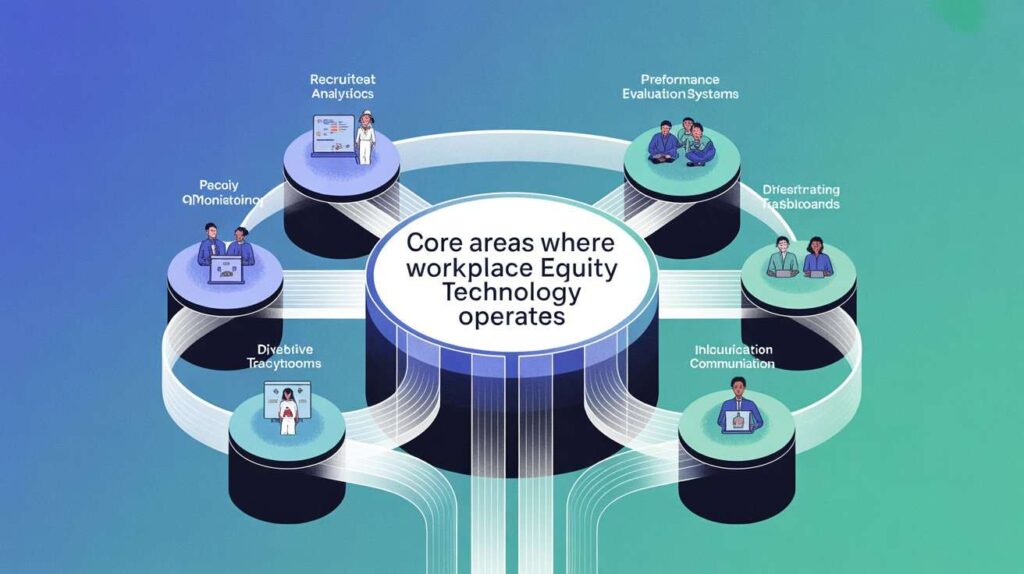
1. Recruitment and Hiring
Hiring is one of the most bias-prone areas in business. Unconscious preferences related to gender, race, age, education, or background can influence decision-making.
Equity-focused recruitment tools:
- Blind resumes by removing identifying information
- Use AI to screen candidates based on skills and competencies
- Standardize interview scoring
- Analyze diversity metrics across hiring stages
- Provide bias alerts to hiring managers
These systems help ensure that the best candidate is selected based on merit rather than subjective impressions.
2. Pay Equity Analysis
Compensation inequality remains one of the most persistent workplace challenges globally.
Workplace equity technology platforms can:
- Analyze salary data across demographics
- Identify unjustified pay gaps
- Compare compensation for similar roles
- Provide audit-ready compliance reports
- Recommend corrective salary adjustments
Instead of relying on annual reviews, companies can monitor pay equity continuously.
3. Performance Management Systems
Traditional performance evaluations frequently face issues related to bias and lack of consistency. Some employees may receive higher ratings due to visibility, personal relationships, or subjective perceptions.
Modern equity-focused performance tools:
- Use standardized evaluation criteria
- Track measurable KPIs
- Provide multi-source feedback
- Analyze rating trends across demographics
- Flag patterns of potential bias
This creates a more transparent and objective evaluation environment.
4. Promotion and Career Advancement Tracking
Career progression often lacks visibility. Employees may not understand why certain colleagues advance faster.
Technology can:
- Map career pathways
- Track internal mobility data
- Identify promotion disparities
- Recommend mentorship matches
- Ensure leadership pipelines reflect organizational diversity
This ensures advancement opportunities are fairly distributed.
5. Workplace Culture Monitoring
Digital tools now measure employee sentiment and inclusion through:
- Anonymous surveys
- Real-time feedback platforms
- Engagement analytics
- Inclusion dashboards
- AI-powered sentiment analysis
Companies can identify exclusion trends early and address cultural concerns proactively.
The Role of Artificial Intelligence in Equity
Artificial intelligence plays a significant role in modern workplace equity technology. However, AI itself must be designed carefully to avoid reinforcing bias.
Responsible AI systems:
- Are trained on diverse datasets
- Undergo regular bias audits
- Offer explainable decision models
- Provide transparency in scoring mechanisms
- Allow human oversight
When implemented ethically, AI enhances fairness rather than undermines it.
Benefits of Workplace Equity Technology
1. Increased Transparency
Employees can see clear criteria for hiring, evaluation, and promotion decisions. Transparency builds trust.
2. Improved Employee Retention
Fair environments reduce turnover and increase loyalty.
3. Stronger Employer Brand
Organizations known for equity attract top talent.
4. Legal Risk Reduction
Data-backed systems reduce discrimination claims and compliance risks.
5. Higher Productivity
Engaged employees perform better when they feel valued and respected.
6. Enhanced Innovation
Diverse and equitable teams generate broader ideas and creative solutions.
Challenges in Implementing Workplace Equity Technology
Although the advantages are evident, putting it into practice can be challenging.
1. Resistance to Change
Some leaders may feel threatened by transparency.
2. Data Privacy Concerns
Employee data must be handled securely and ethically.
3. Algorithmic Bias
If poorly designed, AI systems may replicate historical inequalities.
4. Cost and Infrastructure
Smaller organizations may struggle with budget limitations.
5. Overreliance on Technology
Technology should support—not replace—human leadership and accountability.
Best Practices for Adoption
To maximize impact:
- Conduct a baseline equity audit.
- Involve leadership early.
- Communicate transparently with employees.
- Train managers on bias awareness.
- Regularly monitor and update systems.
- Combine technology with human judgment.
Successful adoption requires cultural commitment alongside digital tools.
Real-World Applications Across Industries
Technology Sector
Tech companies use equity dashboards to track pay gaps and hiring diversity metrics.
Healthcare
Hospitals analyze promotion pathways to ensure equitable advancement among staff.
Education
Universities use technology to ensure fair faculty recruitment and evaluation processes.
Finance
Financial institutions conduct automated compensation audits to comply with regulations.
The Future of Workplace Equity Technology
As remote and hybrid work models expand, equity challenges evolve. Geographic pay differences, digital inclusion gaps, and performance visibility disparities require new solutions.
Emerging trends include:
- Blockchain for compensation transparency
- Predictive analytics for diversity planning
- Real-time bias detection in communication tools
- Virtual mentorship matching platforms
- Equity-focused workforce planning software
Technology will continue evolving toward proactive equity management rather than reactive correction.
Measuring the Impact of Equity Technology
Organizations should track:
- Pay gap reduction percentages
- Promotion rate parity
- Hiring diversity ratios
- Employee satisfaction scores
- Retention improvements
- Complaint reduction metrics
Quantifiable outcomes ensure sustained progress.
Ethical Considerations
Technology must align with ethical values:
- Transparency in data usage
- Informed employee consent
- Secure data storage
- Regular fairness audits
- Clear accountability structures
Equity should never become a superficial marketing strategy. Authentic implementation matters.
Building a Culture Beyond Technology
While digital tools are powerful, workplace equity technology works best when integrated into a broader culture of respect and inclusion.
Leaders must:
- Model equitable behavior
- Address discrimination swiftly
- Encourage open dialogue
- Support mentorship initiatives
- Promote diverse leadership representation
Technology amplifies fairness—but culture sustains it.
Final Thoughts
Workplace equity technology represents one of the most significant shifts in modern organizational management. It moves equity from abstract ideals into measurable systems. By embedding fairness into hiring, compensation, performance, and promotion processes, companies create environments where talent truly thrives. In a competitive global economy, organizations that prioritize equity are not only ethically responsible—they are strategically stronger.
However, technology alone is not a complete solution. It must operate alongside ethical leadership, transparent communication, and ongoing evaluation. When used thoughtfully, workplace equity technology empowers businesses to build trust, reduce systemic bias, and create inclusive cultures that support long-term growth. The future of work depends on fairness, and technology is becoming one of its most powerful enablers.
Frequently Asked Questions (FAQs) about workplace equity technology
1. What is workplace equity technology?
Workplace equity technology refers to digital tools, software platforms, analytics systems, and artificial intelligence applications designed to promote fairness, inclusion, and equal opportunity in organizations. These systems help identify and eliminate systemic inequalities in hiring, compensation, promotions, performance management, and workplace culture by using measurable, data-driven methods.
2. How does workplace equity technology differ from diversity initiatives?
Diversity initiatives primarily focus on representation—ensuring a workforce includes people from different backgrounds. Workplace equity technology, however, focuses on fairness within systems. It ensures processes such as pay, evaluation, and promotions are unbiased and transparent, regardless of demographic representation.
3. Why is workplace equity technology important in modern organizations?
Modern employees expect fairness, transparency, and accountability. Additionally, investors and stakeholders increasingly evaluate companies based on ESG (Environmental, Social, and Governance) criteria. Workplace equity technology allows organizations to proactively address inequities, reduce risk, and build stronger, more inclusive cultures that support long-term growth.
4. How does workplace equity technology improve recruitment processes?
Equity-focused recruitment tools can blind resumes, standardize interview scoring, and use AI to assess candidates based on skills rather than personal characteristics. They also track diversity metrics throughout hiring stages and provide bias alerts to managers, helping ensure hiring decisions are merit-based and fair.
5. Can workplace equity technology help reduce pay gaps?
Yes. Pay equity platforms analyze salary data across demographics and identify unjustified compensation gaps. They compare pay for similar roles, generate compliance reports, and recommend corrective adjustments. This allows companies to continuously monitor pay equity rather than relying solely on annual reviews.
6. What role does artificial intelligence play in workplace equity technology?
Artificial intelligence supports standardized decision-making, data analysis, and bias detection. However, AI must be designed responsibly. Ethical AI systems use diverse datasets, undergo regular bias audits, provide transparent decision models, and include human oversight to ensure fairness rather than reinforce existing inequalities.
7. How does workplace equity technology improve performance management?
Traditional performance reviews can be influenced by subjectivity or personal bias. Equity-focused performance systems use measurable KPIs, standardized criteria, and multi-source feedback. They also analyze rating patterns across demographics to detect potential disparities, promoting fair and transparent evaluations.
8. What are the biggest challenges in implementing workplace equity technology?
Key challenges include resistance to transparency, concerns about data privacy, algorithmic bias, implementation costs, and overreliance on technology. Successful adoption requires leadership commitment, proper training, and continuous monitoring to ensure the tools are used ethically and effectively.
9. Is workplace equity technology suitable for small and medium-sized businesses?
Yes. While large enterprises often lead adoption, many scalable, cloud-based platforms are accessible to smaller organizations. Even basic analytics tools can provide meaningful insights into pay equity, promotion patterns, and employee sentiment, making workplace equity technology practical for businesses of all sizes.
10. How can companies measure the effectiveness of workplace equity technology?
Organizations can track measurable outcomes such as pay gap reduction, promotion rate parity, diversity in hiring, employee satisfaction scores, retention rates, and reduced complaints related to discrimination. Consistent tracking ensures accountability and continuous improvement.
11. Does workplace equity technology replace human leadership?
No. Technology supports leadership but does not replace it. Human judgment, ethical leadership, and cultural commitment are essential. Workplace equity technology provides data and insights, but leaders must interpret the results and take meaningful action to build inclusive environments.
12. How does workplace equity technology support remote and hybrid work environments?
As remote and hybrid work expand, new equity challenges emerge, including geographic pay differences and performance visibility issues. Workplace equity technology helps monitor these disparities, ensuring fair compensation structures, inclusive communication practices, and equal advancement opportunities regardless of location.
13. What ethical considerations are associated with workplace equity technology?
Organizations must ensure transparency in data usage, secure storage of employee information, informed consent, and regular fairness audits. Equity tools should not be used as superficial marketing tactics but as genuine mechanisms to create sustainable fairness within the organization.
14. What is the future of workplace equity technology?
The future includes predictive analytics for diversity planning, blockchain for compensation transparency, real-time bias detection in digital communication tools, and advanced workforce planning systems. As technology evolves, equity management will become more proactive, data-driven, and integrated into core business strategy.
ALSO READ
The Truth About Chas6d And Smart Automation