
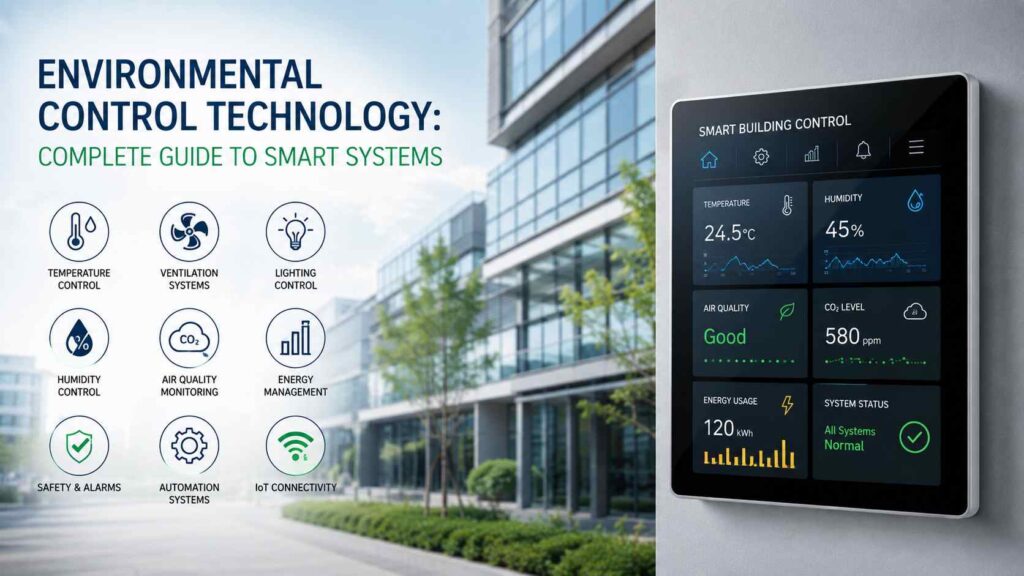
Modern spaces depend on precise control of temperature, humidity, air quality, lighting, and energy use. However, outdated systems often waste resources, reduce comfort, and fail to respond quickly to changing conditions. Environmental control technology solves these problems through smart sensors, automated controls, and connected equipment.
This guide explains how smart environmental systems work, where they are used, and what benefits they provide. It also covers their main components, applications, challenges, maintenance requirements, and future developments. Readers will gain practical insights into improving safety, efficiency, comfort, and environmental performance.
What Is Environmental Control Technology?
Environmental control technology refers to systems, equipment, software, and processes used to monitor, regulate, and improve conditions within a specific environment.
The environment may be a residential building, commercial property, industrial facility, greenhouse, hospital, laboratory, vehicle, aircraft, or any other controlled space.
These systems may control one or several environmental factors, including:
- Indoor temperature
- Humidity levels
- Air circulation
- Air pressure
- Carbon dioxide levels
- Dust and airborne particles
- Harmful gases
- Lighting conditions
- Noise levels
- Water quality
- Energy consumption
- Waste emissions
The main purpose of environmental control technology is to maintain safe, comfortable, efficient, and stable conditions.
For example, a home environmental control system may adjust room temperature and ventilation. A hospital system may maintain strict air pressure and filtration requirements. An industrial system may detect harmful gases and activate emergency ventilation.
The scale and complexity of the system depend on the environment being controlled.
How Environmental Control Technology Works
Most environmental control systems follow a basic process: monitor conditions, analyze information, make a decision, and activate the appropriate equipment.
Sensors continuously collect environmental data. A control unit compares that data with predetermined limits or desired settings. When the system detects a difference, it sends instructions to connected devices.
For example, when the temperature rises above a selected level, the controller may activate an air-conditioning system. When carbon dioxide levels increase, it may increase the supply of fresh air.
More advanced systems can consider several conditions simultaneously. They may also analyze historical patterns, weather forecasts, occupancy levels, and energy prices before making adjustments.
Environmental Sensors
Sensors are the foundation of most environmental control systems. They detect physical or chemical changes and convert them into measurable data.
Common environmental sensors include:
- Temperature sensors
- Humidity sensors
- Carbon dioxide sensors
- Smoke detectors
- Motion sensors
- Light sensors
- Pressure sensors
- Gas detectors
- Water-quality sensors
- Particulate-matter sensors
The accuracy of the overall system depends heavily on the quality, positioning, maintenance, and calibration of these sensors.
A poorly positioned temperature sensor, for example, may produce inaccurate readings if it is placed near direct sunlight, an air vent, or heat-generating equipment.
Controllers and Processing Units
The controller acts as the decision-making component of the system. It receives information from sensors and determines what action should be taken.
Basic controllers use predefined rules. A simple thermostat, for instance, activates heating when the temperature falls below a selected point.
Advanced controllers may use software algorithms, predictive models, or artificial intelligence. They can process information from multiple sensors and make more complex decisions.
Controllers may be installed locally inside a building or connected to a centralized cloud platform.
Actuators and Connected Equipment
Actuators perform the physical actions requested by the controller. They can open valves, adjust dampers, activate fans, switch lights, change motor speeds, or operate heating and cooling systems.
Examples of connected equipment include:
- Air-conditioning units
- Heating systems
- Ventilation fans
- Air filters
- Humidifiers
- Dehumidifiers
- Motorized windows
- Water pumps
- Lighting systems
- Exhaust systems
Without actuators and connected equipment, the control system could monitor conditions but would not be able to change them.
Monitoring Software and User Interfaces
Modern systems often include dashboards that allow building owners, technicians, or facility managers to view environmental conditions in real time.
These dashboards may display temperature, energy use, humidity, equipment status, maintenance alerts, and historical trends.
Users can normally change settings, schedule operations, receive notifications, and compare performance between different areas of a building.
Remote access also allows technicians to identify problems without being physically present at the location.
Main Types of Environmental Control Technology
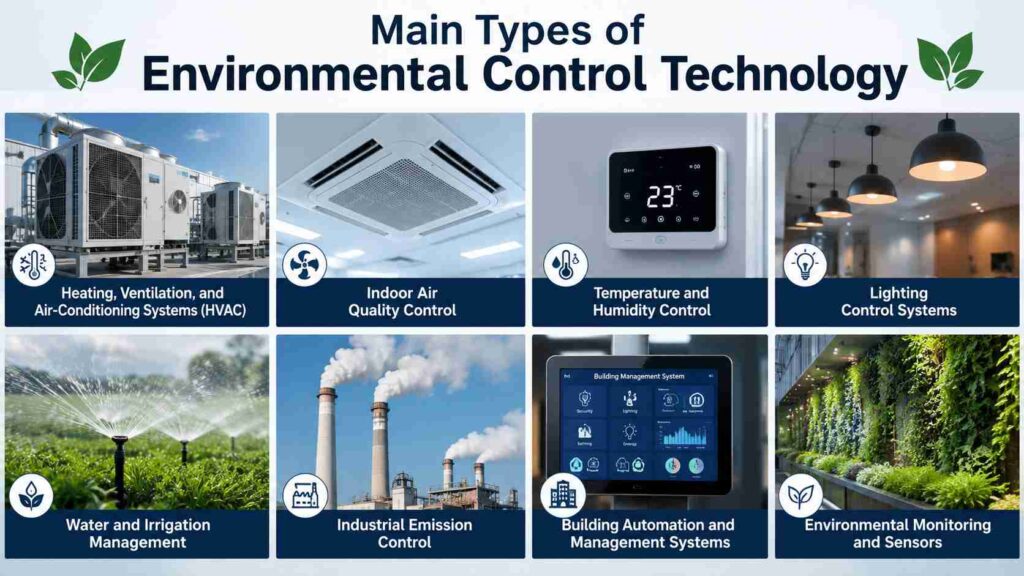
Environmental control technology includes several categories. Some systems focus on human comfort, while others are designed for safety, industrial performance, product quality, or environmental protection.
Heating, Ventilation, and Air-Conditioning Systems
Heating, ventilation, and air-conditioning systems are among the most common forms of environmental control.
These systems regulate indoor temperature, airflow, humidity, and ventilation. They are used in homes, offices, schools, hospitals, shopping centers, hotels, and industrial facilities.
Modern HVAC systems can include variable-speed motors, smart thermostats, occupancy sensors, energy-management software, and automated ventilation controls.
Instead of operating continuously at full power, advanced systems can adjust their output according to actual demand.
Indoor Air Quality Control
Indoor air quality systems monitor and reduce pollutants that may affect human health, comfort, or productivity.
These pollutants may include:
- Dust
- Smoke
- Pollen
- Mold spores
- Volatile organic compounds
- Carbon monoxide
- Carbon dioxide
- Fine particulate matter
- Chemical fumes
Air-quality systems may use filtration, ventilation, purification, ultraviolet treatment, or activated carbon.
In commercial buildings, carbon dioxide sensors are often used as an indirect indication of occupancy and ventilation requirements.
Temperature and Humidity Control
Changes in temperature and humidity can influence human comfort, machine performance, product quality, construction materials, and electronic devices.
Excessive humidity may encourage mold growth, corrosion, condensation, and material damage. Very low humidity can cause discomfort, static electricity, and damage to sensitive products.
Temperature and humidity control is especially important in museums, warehouses, laboratories, pharmaceutical facilities, food-storage areas, and data centers.
Lighting Control Systems
Lighting control systems manage artificial light according to occupancy, daylight levels, schedules, and user preferences.
Motion sensors can switch lights off when rooms are empty. Daylight sensors can reduce artificial lighting when sufficient sunlight is available.
These systems improve energy efficiency and may also support more comfortable working conditions.
Water and Irrigation Control
Water-control technology monitors water usage, pressure, quality, leakage, and distribution.
Smart irrigation systems use soil-moisture sensors, weather information, and plant requirements to determine when watering is necessary.
In buildings, leak-detection systems can identify unusual water flow and automatically shut off the supply before extensive damage occurs.
Industrial Emission Control
Industrial environmental systems control dust, fumes, heat, gases, wastewater, and other emissions produced during manufacturing.
These systems may include:
- Dust collectors
- Scrubbers
- Exhaust ventilation
- Gas monitoring
- Wastewater treatment
- Heat-recovery equipment
- Emission sensors
Industrial control systems protect employees, equipment, nearby communities, and the surrounding environment.
Applications of Environmental Control Technology
Environmental control systems are used across many industries. Each application has different performance, safety, and regulatory requirements.
Homes and Residential Buildings
In residential buildings, environmental technology improves comfort, air quality, security, and energy efficiency.
Smart thermostats can learn household schedules and adjust heating or cooling automatically. Connected air-quality sensors can detect smoke, carbon monoxide, humidity, and airborne particles.
Some systems can also control blinds, lighting, ceiling fans, air purifiers, and ventilation equipment through a single mobile application.
Offices and Commercial Properties
Commercial buildings may contain hundreds of rooms with different occupancy and temperature requirements.
A building-management system can monitor multiple zones and adjust conditions separately. Meeting rooms may receive additional ventilation when occupied, while unused spaces may operate at reduced capacity.
Commercial systems can also generate energy reports, identify malfunctioning equipment, and help facility managers schedule maintenance.
Hospitals and Healthcare Facilities
Hospitals require precise control of temperature, air pressure, ventilation, filtration, and cleanliness.
Operating rooms, isolation rooms, pharmacies, laboratories, and patient areas may require different environmental conditions.
Negative-pressure rooms prevent contaminated air from spreading into surrounding areas. Positive-pressure rooms prevent outside contaminants from entering sensitive spaces.
Reliable environmental controls are therefore directly connected to infection prevention, patient safety, and clinical operations.
Laboratories and Cleanrooms
Laboratories and cleanrooms require stable environmental conditions because small changes can affect experiments, products, or manufacturing processes.
Environmental systems may control airborne particles, pressure differences, temperature, humidity, chemical fumes, and airflow direction.
Pharmaceutical, biotechnology, semiconductor, aerospace, and medical-device industries commonly use cleanroom technology.
Manufacturing and Industrial Facilities
Factories use environmental controls to protect workers, equipment, and products.
For example, a manufacturing facility may use exhaust ventilation to remove fumes, cooling systems to prevent machinery from overheating, and dust collectors to control airborne particles.
Automated monitoring can also detect gas leaks, unusual temperatures, or ventilation failures before they become serious safety incidents.
Agriculture and Greenhouses
Agricultural environmental systems help growers manage temperature, humidity, soil moisture, light, carbon dioxide, and irrigation.
In greenhouses, automated systems can open vents, activate fans, adjust shade screens, control heating, and deliver water according to plant requirements.
This creates more stable growing conditions and reduces dependence on manual observation.
Indoor farms use even more precise environmental controls because plants depend entirely on artificial lighting, ventilation, nutrients, and water systems.
Data Centers
Data centers contain servers that produce significant amounts of heat. Excessive temperature or humidity can reduce equipment performance and increase the risk of failure.
Environmental controls monitor airflow, cooling capacity, temperature differences, humidity, and energy usage.
Some data centers use intelligent cooling systems that adjust fan speeds and cooling output based on server demand.
Transportation and Aerospace
Cars, trains, ships, aircraft, and spacecraft rely on environmental control systems to maintain safe conditions for passengers, crews, equipment, and cargo.
Aircraft environmental systems regulate cabin temperature, air pressure, oxygen levels, and ventilation.
Spacecraft require advanced life-support and environmental control systems because there is no natural atmosphere available to support human life.
Benefits of Environmental Control Technology
The value of environmental control technology extends beyond simple temperature regulation.
Improved Comfort
Automatic control helps maintain stable temperature, humidity, airflow, and lighting.
This reduces uncomfortable fluctuations and allows different spaces to operate according to their specific requirements.
Better Indoor Air Quality
Air-quality monitoring allows systems to respond when pollutants, carbon dioxide, or humidity reach undesirable levels.
Improved ventilation and filtration can create healthier indoor conditions, especially in crowded buildings.
Greater Energy Efficiency
Traditional systems may continue operating even when spaces are empty or conditions are already acceptable.
Smart controls use sensors, schedules, and real-time demand to reduce unnecessary operation.
This can lower electricity consumption, fuel usage, and overall operating costs.
Equipment Protection
Stable environmental conditions can protect servers, machines, medicines, documents, artwork, food, and sensitive electronic equipment.
Early warnings also help technicians respond before overheating, moisture, or contamination causes permanent damage.
Improved Safety
Environmental monitoring systems can identify smoke, toxic gases, excessive heat, water leaks, and ventilation failures.
Automated alarms and emergency responses can reduce the time required to address hazardous conditions.
More Consistent Product Quality
Manufacturing, food processing, pharmaceuticals, and agriculture often require stable environmental conditions.
Automated control reduces variation and helps maintain consistent product quality.
Better Operational Data
Environmental platforms collect information over time. Organizations can use this data to identify patterns, improve maintenance, compare locations, and make better investment decisions.
Environmental Control Technology and Energy Efficiency
Buildings consume energy through heating, cooling, ventilation, lighting, equipment, and water systems.
Environmental control technology can reduce waste by matching system output with actual demand.
An occupancy sensor, for example, may detect that a room is empty and reduce ventilation or lighting. A smart thermostat may adjust the temperature before people arrive rather than maintaining the same setting throughout the night.
Variable-speed fans and pumps can operate at lower speeds when full capacity is unnecessary. Automated blinds can reduce solar heat during hot periods and allow sunlight during colder periods.
Energy-management software can also identify unusual consumption. A sudden increase may indicate a damaged sensor, leaking valve, blocked filter, or malfunctioning motor.
However, installing smart technology does not automatically guarantee energy savings. Systems must be correctly designed, programmed, commissioned, and maintained.
Role of Artificial Intelligence and IoT
The Internet of Things allows sensors, controllers, machines, and software platforms to exchange information through connected networks.
Instead of operating as separate devices, environmental systems can work together.
For example, a connected building system may combine weather information, occupancy data, indoor temperature, energy prices, and equipment performance before deciding how to operate.
Artificial intelligence adds another level of analysis.
AI-based environmental systems can identify patterns, predict future conditions, detect unusual behavior, and optimize operations.
A predictive system may determine that a room will become too warm within the next hour. It can begin cooling gradually instead of waiting until the temperature exceeds the limit.
AI can also support predictive maintenance. By analyzing vibration, temperature, power use, and historical performance, the system may detect signs of equipment failure before a breakdown occurs.
These capabilities can improve reliability, but they also require accurate data, secure networks, and proper human oversight.
Challenges of Environmental Control Systems
Although environmental technology provides significant benefits, it also introduces several challenges.
Installation Cost
Advanced sensors, controllers, software, wiring, networking, and equipment can require a substantial initial investment.
Older buildings may need additional modifications before modern systems can be installed.
System Complexity
A system containing products from multiple manufacturers may be difficult to integrate.
Different communication protocols, software platforms, and device standards can create compatibility problems.
Maintenance Requirements
Sensors can become inaccurate over time. Filters become dirty, batteries fail, valves become stuck, and software requires updates.
A poorly maintained smart system may operate less effectively than a simple well-maintained system.
Cybersecurity Risks
Connected environmental systems may be vulnerable to unauthorized access if networks, passwords, devices, and software are not properly secured.
A compromised system could expose building information or allow someone to change important settings.
Data Privacy
Occupancy sensors, cameras, access systems, and connected devices may collect information about how people use a building.
Organizations should establish clear rules regarding data collection, storage, access, and retention.
Dependence on Accurate Data
Automated decisions are only as reliable as the information received from sensors.
Incorrect calibration, poor sensor placement, network failure, or incomplete data can lead to unsuitable system responses.
How to Select an Environmental Control System
Choosing the right system requires more than selecting the newest technology.
The first step is to define the conditions that need to be controlled. A homeowner may focus on comfort and energy costs, while a laboratory may require exact temperature, humidity, pressure, and particle limits.
Important factors include:
- Size of the property
- Number of rooms or zones
- Required environmental conditions
- Existing HVAC and electrical equipment
- Local climate
- Safety requirements
- Energy goals
- Maintenance resources
- Software compatibility
- Expansion plans
- Cybersecurity requirements
- Available budget
Buyers should also consider whether the system can integrate with existing equipment. Replacing every device may be unnecessary if a new controller can communicate with the current infrastructure.
Operators should be able to understand and use the system without unnecessary difficulty. Complicated dashboards and excessive automation can create problems when employees do not receive sufficient training.
Maintaining Environmental Control Technology
Regular maintenance is necessary for reliable performance.
Sensors should be inspected and calibrated according to manufacturer recommendations. Air filters, fans, pumps, valves, motors, and ventilation equipment should also be checked regularly.
Software updates should be installed to improve security and compatibility. Backup procedures should be established for important settings and system data.
Facility managers should review alarms and performance reports rather than ignoring repeated notifications.
A system that constantly produces false alarms may have incorrect thresholds, damaged sensors, or poor programming.
Periodic testing should confirm that emergency functions work properly. This may include smoke detection, gas alarms, automatic shutdowns, ventilation activation, and water shutoff systems.
Future of Environmental Control Technology
Environmental systems are becoming more connected, predictive, and responsive.
Future platforms will likely combine building data with weather forecasts, renewable energy production, battery storage, electricity prices, occupancy patterns, and equipment conditions.
Buildings may automatically shift energy consumption to periods when electricity is cleaner or less expensive.
More systems will also use wireless sensors, edge computing, digital twins, and machine learning.
A digital twin is a virtual representation of a physical building, machine, or environmental system. Operators can use it to test changes, identify inefficiencies, and predict performance without disrupting the actual facility.
Environmental controls may also become more personalized. Instead of applying the same temperature and lighting settings to an entire building, systems may respond to individual zones, tasks, and preferences.
However, human supervision will remain important. Automated systems should support informed decision-making rather than completely replacing professional judgment.
Final Thoughts on Environmental Control Technology
Environmental control technology helps create safer, healthier, more comfortable, and more efficient environments. By combining sensors, controllers, software, and connected equipment, these systems can monitor changing conditions and respond more accurately than traditional manual controls.
As environmental control technology continues to develop, artificial intelligence, connected devices, predictive maintenance, and energy optimization will play increasingly important roles. Organizations that invest in these systems should also prioritize proper design, cybersecurity, staff training, calibration, and long-term maintenance to achieve reliable results.
FAQs about environmental control technology
1. What is environmental control technology?
Environmental control technology includes systems used to monitor and manage conditions such as temperature, humidity, ventilation, air quality, lighting, pressure, water usage, and energy consumption.
2. What is an example of an environmental control system?
A smart HVAC system is a common example. It uses sensors and controllers to adjust heating, cooling, airflow, and ventilation according to indoor conditions.
3. Where is environmental control technology used?
It is used in homes, offices, hospitals, laboratories, factories, greenhouses, farms, data centers, vehicles, aircraft, warehouses, and many other controlled environments.
4. How does an environmental control system work?
Sensors measure environmental conditions. A controller analyzes the information and sends instructions to equipment such as fans, heaters, air conditioners, pumps, filters, or lighting systems.
5. What conditions can environmental technology control?
It can control temperature, humidity, air pressure, ventilation, lighting, carbon dioxide, airborne particles, harmful gases, water quality, noise, and energy usage.
6. Is HVAC part of environmental control technology?
Yes. HVAC is one of the most widely used forms of environmental control because it regulates heating, cooling, airflow, humidity, and ventilation.
7. Can environmental controls reduce energy consumption?
Yes. Smart controls can reduce unnecessary heating, cooling, ventilation, and lighting by responding to occupancy, schedules, weather, and real-time demand.
8. What is the role of sensors in environmental control?
Sensors collect information about environmental conditions. The control system uses this information to decide whether equipment should be activated, adjusted, or switched off.
9. How does artificial intelligence improve environmental control?
Artificial intelligence can analyze patterns, predict future conditions, detect abnormal equipment behavior, optimize energy use, and support predictive maintenance.
10. Are environmental control systems expensive?
Costs vary according to the size, complexity, equipment, number of sensors, software, installation requirements, and existing infrastructure. Basic residential systems are usually less expensive than industrial or laboratory systems.
11. What are the main disadvantages of smart environmental systems?
Potential disadvantages include installation cost, maintenance requirements, system complexity, cybersecurity risks, software compatibility issues, and dependence on accurate sensor data.
12. Do environmental sensors require maintenance?
Yes. Sensors may require cleaning, battery replacement, inspection, testing, and calibration to maintain accurate performance.
13. What is the difference between monitoring and control?
Monitoring systems collect and display information. Control systems can also take action by adjusting connected equipment when conditions change.
14. Can environmental control systems improve indoor air quality?
Yes. They can monitor pollutants, humidity, carbon dioxide, and airborne particles while controlling ventilation, filtration, purification, and fresh-air supply.
15. What is the future of environmental control technology?
The future includes greater use of artificial intelligence, IoT devices, wireless sensors, digital twins, predictive maintenance, renewable energy integration, and personalized environmental settings.
Continue Reading
Tech Ideas That Made The Web Move Quicker Forever
Beauty Tech News: AI and Future Beauty Innovations
Cross Platform Mobile App Development Services: Complete Guide