
Introduction
In the digital age, data is scattered across various platforms, databases, and websites, making it increasingly difficult to find the exact information you need. What is Federated Search? It is a powerful solution to this problem. Federated Search is a technique that allows users to query multiple data repositories simultaneously through a single search interface. Unlike traditional search engines, which only search one data source at a time, Federated Search aggregates results from various sources and presents them in a unified list. This ability to gather and present comprehensive data from different platforms is a game-changer, particularly in environments where information is siloed in multiple systems.
By querying several databases or platforms at once, Federated Search significantly improves the efficiency of data retrieval, saving time and offering users a broader scope of results. Whether you are looking through academic journals, company databases, or e-commerce platforms, Federated Search provides a seamless experience for retrieving relevant information. In this article, we will dive into the concept of Federated Search, exploring how it works, its benefits, challenges, and applications across different industries. We will also answer some frequently asked questions to clarify any doubts you may have about this technology and its impact on modern data retrieval practices.
What is Federated Search?
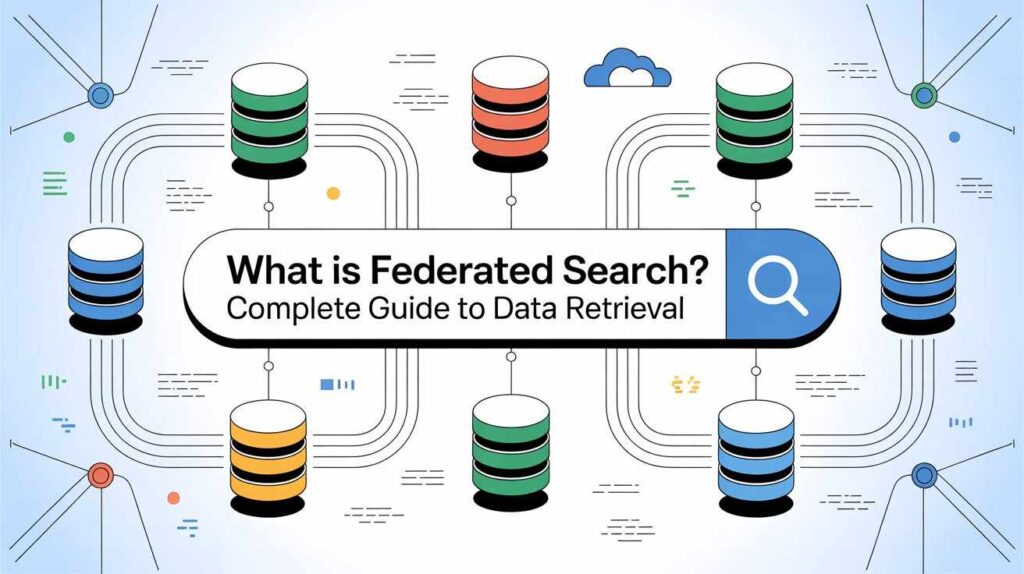
Federated Search is a technique used to query multiple data repositories simultaneously from a single search interface. Rather than searching through one source, Federated Search allows users to search across multiple databases, websites, or systems at the same time and combines the results into one unified output. This process offers a seamless way to gather information from various sources, streamlining the search experience.
The advantage of Federated Search lies in its ability to provide comprehensive results by aggregating data from numerous sources. This capability is particularly useful in environments where data is dispersed across multiple platforms, making it difficult to locate the information needed without sifting through each source individually.
Whether you’re searching across public websites, proprietary enterprise databases, or academic journals, Federated Search can be a vital tool. As organizations increasingly store their data across different systems—both internal and external—this method of querying multiple sources simultaneously becomes an essential component of modern data retrieval.
In this article, we’ll explore Federated Search in detail: what it is, how it works, its applications, benefits, and why it is considered a crucial tool for accessing information in today’s digital world.
How Does Federated Search Work?
Federated Search provides an efficient method for searching across multiple data sources simultaneously. The system retrieves and combines data from various repositories, making it much faster and easier for users to access the information they need. Below is a more detailed explanation of how Federated Search works:
1. User Input: The Search Begins
The process begins when a user enters a search query into the centralized Federated Search interface. This interface could be embedded in a website, a business application, or even an enterprise platform. Instead of being restricted to a single data repository, this search query will be distributed across various platforms, databases, and sources.
2. Query Distribution to Multiple Sources
Once the search query is received, the Federated Search system distributes it to multiple connected data sources. These could include content management systems, websites, proprietary databases, or cloud-based platforms. Each source will search its data independently to find the relevant information.
3. Data Crawlers Fetch Relevant Content
Automated crawlers or API integrations fetch relevant data based on the user’s search query. The crawlers access each data repository to extract information that matches the search terms. Since these data sources can vary in structure, the crawlers are typically designed to understand the specifics of each source, ensuring that no relevant data is overlooked.
4. Aggregation of Search Results
After fetching results from multiple sources, the Federated Search engine aggregates these responses into a single unified output. This step is critical because it organizes and combines information into a coherent list of search results, ensuring that all sources contribute to the final list.
5. Ranking and Filtering for Relevance
Once all results are aggregated, they are typically ranked by relevance. Relevance is determined based on various factors such as keyword matching, source credibility, and user preferences. The search results may also be filtered according to specific criteria to allow users to narrow down their search, ensuring they receive the most pertinent information.
6. Displaying Results
Finally, the results are displayed to the user in an easy-to-read format. This presentation is typically user-friendly, with the most relevant results highlighted. Users may also be provided with links to the full content, brief summaries, or even interactive elements, depending on the platform.
The Benefits of Federated Search

Federated Search offers a wide range of benefits, especially in environments where data is scattered across different repositories. The following are some key advantages:
1. Efficiency in Data Retrieval
One of the biggest advantages of Federated Search is its ability to search across multiple data repositories simultaneously. This eliminates the need for users to conduct separate searches in different systems, saving time and improving productivity.
2. Access to Comprehensive Results
By aggregating results from various sources, Federated Search provides users with a more comprehensive overview of the data available. Instead of retrieving fragmented results from different platforms, users are presented with a unified list that contains information from all connected sources.
3. Improved User Experience
Federated Search offers a simplified user experience by consolidating search results into a single interface. This makes it easier for users to find the information they need without navigating between multiple websites or platforms.
4. Cost-Effectiveness
For businesses, Federated Search can be more cost-effective than purchasing and managing separate search tools for each database or data source. It reduces the need for custom search solutions for every individual system, allowing for a more streamlined approach.
5. Better Decision-Making
Federated Search can accelerate the decision-making process by providing access to all relevant information in a single query. This is especially valuable in industries like healthcare, law, or business, where access to accurate and timely data can be crucial.
Applications of Federated Search
Federated Search is used across various industries and environments to streamline data retrieval and improve the efficiency of operations. Here are some examples of where Federated Search is applied:
1. Enterprise Search
In large organizations, employees often need to search across different internal systems—such as customer databases, internal documentation, and email servers. Federated Search allows employees to query multiple repositories at once, saving time and providing them with a comprehensive set of results from different systems.
2. Academic Research
Researchers and academics frequently rely on Federated Search to locate research papers, academic journals, and scholarly articles. By querying multiple academic databases such as JSTOR, Google Scholar, and PubMed simultaneously, researchers can access a broader range of resources, facilitating better-informed studies.
3. E-Commerce
In the e-commerce sector, Federated Search is used to retrieve results from multiple product categories, brands, and vendors. By integrating various databases and product listings, customers can see a unified view of available products, making it easier to compare options and make informed purchasing decisions.
4. Healthcare
In healthcare, Federated Search helps medical professionals quickly access patient records, clinical research, and medical journals from multiple databases. This is critical in environments where timely and accurate information is necessary for patient care.
5. Legal Sector
Lawyers and legal professionals use Federated Search to search through various sources of legal data, including case law, statutes, and regulations. This helps them find relevant information quickly and accurately, which is crucial in preparing cases or conducting legal research.
Challenges of Federated Search
While Federated Search provides significant benefits, it does come with its share of challenges:
1. Data Inconsistency
Different data sources may store and present data in different formats. This can make it difficult to aggregate and display results in a unified manner. Data consistency across multiple sources is a significant challenge for Federated Search.
2. Latency
Since Federated Search queries multiple data sources at once, the retrieval process may take longer compared to searching through a single source. The size and location of data repositories also affect the time it takes for results to be returned, leading to potential delays.
3. Security and Privacy Concerns
Federated Search systems need to ensure that users only have access to authorized data. Different data sources may have different levels of security, and it’s important to manage access permissions properly to avoid unauthorized access.
4. Integration Complexity
Integrating various data sources—each potentially using different technologies or platforms—can be complex. Organizations must invest in the right infrastructure to ensure smooth communication between different systems and avoid bottlenecks or failures in the search process.
5. Scalability Issues
As the volume of data grows, Federated Search systems must scale to handle an increasing number of queries and data sources. Ensuring that the system remains efficient as the volume of data expands can be challenging.
Federated Search vs. Traditional Search Engines
The primary difference between Federated Search and traditional search engines lies in the type of data they query. Traditional search engines, such as Google, typically query one central index (websites). Federated Search, on the other hand, can query multiple, diverse data sources (databases, repositories, websites), making it more powerful for specialized searches in business, academia, and other fields.
Why is Federated Search Important?
Federated Search plays a crucial role in simplifying the data retrieval process, especially in environments where multiple data sources are involved. As more organizations and institutions adopt cloud-based systems, the need for Federated Search becomes even more pronounced. By providing a unified view of data, Federated Search saves time, enhances decision-making, and improves user satisfaction.
Final Thoughts
What is Federated Search? It revolutionizes how we search for and access data by consolidating information from multiple repositories into one simple, user-friendly interface. This allows users to view all available data in a unified format. In today’s data-driven world, where information is dispersed across various systems, databases, and platforms, Federated Search has become an essential tool for efficiently retrieving comprehensive data.
While it offers substantial benefits in terms of efficiency, user experience, and decision-making, Federated Search also presents challenges in terms of data integration, security, and latency. However, as technology continues to advance, these challenges are becoming more manageable, making Federated Search a vital tool for anyone who needs to retrieve relevant information quickly and effectively.
In the future, we can expect Federated Search to evolve further, offering even better integration capabilities, faster performance, and more accurate results. Whether you’re working in business, healthcare, academia, or e-commerce, Federated Search will continue to be an indispensable part of data retrieval systems.
Frequently Asked Questions (FAQs) About What is Federated Search
1. What is Federated Search?
Federated Search is a search technique that enables users to query multiple data repositories at once, combining the results from various sources into a unified output. This helps streamline the search experience by gathering relevant information from various platforms.
2. How does Federated Search work?
Federated Search works by sending a search query to multiple databases or systems simultaneously. The results from each source are fetched, aggregated, ranked by relevance, and displayed in a unified list to the user.
3. What are the main advantages of Federated Search?
Federated Search offers several benefits, including enhanced efficiency by querying multiple sources at once, access to comprehensive results from various platforms, improved user experience, cost-effectiveness for businesses, and faster decision-making through quick access to relevant data.
4. How is Federated Search different from traditional search engines like Google?
Unlike traditional search engines, which query a single index (like websites), Federated Search queries multiple data sources simultaneously. This makes Federate Search more powerful for specialized searches in business, academia, and other industries that require access to diverse data sources.
5. In which industries is Federated Search commonly used?
Various industries, including enterprise search, academic research, e-commerce, healthcare, and the legal sector, use Federate Search. It helps professionals in these fields access multiple data sources with ease and efficiency.
6. What are the challenges of using Federated Search?
Some of the challenges of Federate Search include data inconsistency across sources, latency in querying multiple data sources, security and privacy concerns, integration complexity, and scalability issues as the volume of data grows.
7. Does Federated Search ensure security?
Federated Search can be secure, but it requires proper access control and security measures to ensure that only authorized users can access sensitive or private data. Different data sources may have varying levels of security, so managing permissions is critical.
8. Can cloud-based systems integrate Federated Search?
Yes, cloud-based systems commonly integrate Federate Search, allowing users to search across cloud storage, databases, and third-party platforms. This integration is especially useful in modern business environments that rely on cloud infrastructure.
9. Does Federated Search save time?
Yes, Federate Search saves time by allowing users to search across multiple repositories with a single query. This eliminates the need to search each platform or database separately, which can be time-consuming.
10. How does Federated Search help in decision-making?
By providing comprehensive and relevant results from multiple data sources, Federate Search helps users access the information they need quickly. This improves decision-making, particularly in industries like healthcare, law, and business, where timely and accurate data is critical.
11. Can academic researchers use Federated Search for their research?
Yes, researchers widely use Federate Search to query multiple academic databases simultaneously, such as JSTOR, PubMed, and Google Scholar. It enables researchers to access a broader range of scholarly articles and resources, facilitating better-informed studies.
12. What are the key components of Federated Search?
The key components of Federate Search include a centralized search interface, multiple data sources, data crawlers, an aggregation engine, and a result presentation layer. Together, these components enable seamless searching and data retrieval across various systems.
13. Can Federated Search scale for large data volumes?
While Federate Search can handle large data volumes, scalability can become a challenge as the number of data sources and the volume of data increases. To remain efficient, Federate Search systems must optimize to handle larger datasets without compromising performance.
14. Can the e-commerce industry use Federated Search?
Yes, e-commerce platforms commonly use Federate Search to query product listings from different categories, vendors, and databases. This allows customers to access a unified view of available products and compare options, which enhances their shopping experience.
15. What is the role of data crawlers in Federated Search?
Data crawlers, automated tools, actively search through various data repositories and extract relevant content based on the user’s query. These crawlers navigate the specific structure and format of each data source to ensure they fetch all relevant data.
ALSO READ
Global Technology Audit Guide: Best Practices And Insights
Fappelo: Transforming Online Communities For A Better Future
How Future Healthcare Technology is Elevating At-Home Care Solutions