
Introduction
A State Wide Area Network has become the cornerstone of modern digital governance. As governments manage vast volumes of data and deliver services across districts, cities, and rural communities, they require a secure and reliable communication framework. This network connects state-level departments, district offices, and grassroots administrative units within a structured environment designed specifically for official administration.
In today’s technology-driven environment, governments cannot rely on fragmented connectivity or paper-based systems. They need a secure backbone that enables real-time coordination, encrypted communication, and seamless service delivery. A State Wide Area Network strengthens administrative efficiency, supports digital transformation, and ensures uninterrupted connectivity across large geographic regions. It empowers governments to modernize public administration while protecting sensitive data and enhancing citizen-centric service delivery.
From enabling online portals to supporting financial, health, and disaster response systems, the State Wide Area Network plays a central role in building transparent, efficient, and accountable governance structures. As digital services expand, this infrastructure continues to shape the future of public sector communication and secure state connectivity.
What Is a State Wide Area Network?
A State Wide Area Network forms a dedicated communication backbone for modern governments. It connects state-level departments, district offices, and local units through a secure channel. Unlike the public internet, this government-owned network ensures secure connectivity, protects sensitive government data, and strengthens administrative workflow automation across geographically distributed offices.
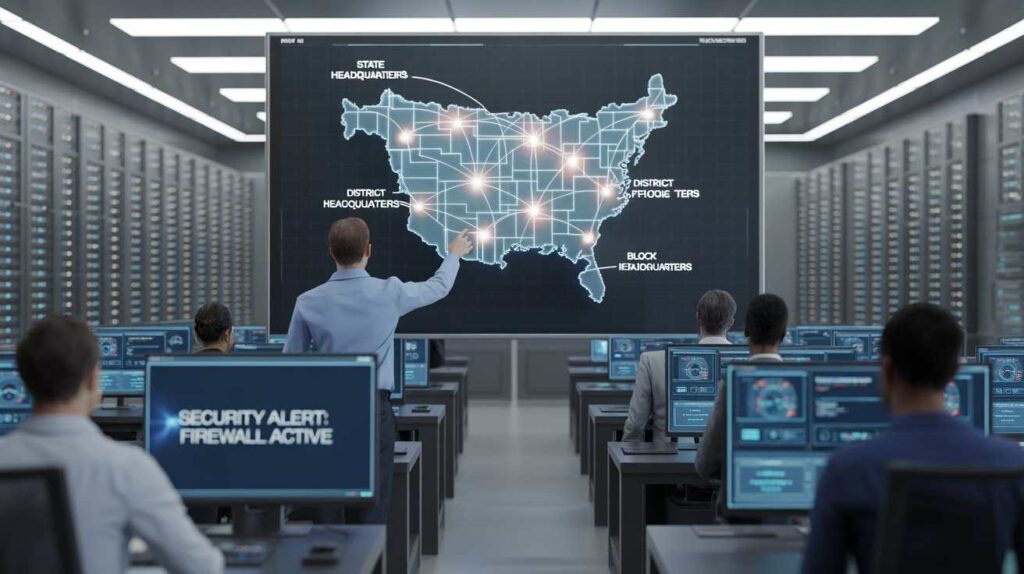
At its core, a State Wide Area Network supports modern e-governance through structured connectivity. It links State Headquarters (SHQ), district hubs, and Block Headquarters (BHQ) within a three-tier network model. This hierarchical communication network ensures consistent data flow management, stable secure connectivity, and seamless coordination between multiple government departments across large geographic areas.
Why State Wide Area Network Matters Today
In the digital age governance environment, governments manage massive data volumes daily. A State Wide Area Network supports digital governance programs by enabling encrypted communication channels and reliable data connectivity. It replaces paper-based procedures and reduces fragmented connectivity. This shift strengthens administrative efficiency improvement and operational integrity.
Moreover, the State Wide Area Network acts as a digital infrastructure backbone. It supports online citizen portals, real-time data access, and inclusive digital services. Through cloud-based platform integration and centralized network management systems, governments modernize public administration systems while improving governance efficiency enhancement and national digital transformation programs.
Core Objectives of State Wide Area Network
The primary goal of a State Wide Area Network is to build a unified communication platform for government operations. It ensures secure transmission of official data through encryption protocols and secure data communication platforms. This framework supports government applications, policy implementation support, and structured digital governance infrastructure.
Another objective involves reducing operational limitations. By ensuring uninterrupted digital access and dedicated bandwidth allocation, the network enhances efficient coordination across administrative tiers. It strengthens inter-government communication, supports collaborative governance, and builds a governance strengthening framework for citizen-centric governance.
Enabling Secure Government Communication Infrastructure
A State Wide Area Network provides secure government connectivity through restricted government access. It uses network firewalls, encrypted data transmission, and authentication mechanisms to prevent unauthorized access and data breaches. These network security safeguards create a controlled network environment.
Strengthening Interdepartmental Digital Collaboration
Through horizontal connectivity models, departmental offices connectivity improves dramatically. Real-time information sharing and integrated database connectivity allow seamless collaboration. Agencies integration reduces silos and enhances administrative coordination systems for faster decision-making.
Delivering Reliable Citizen-Centric Public Services
The State Wide Area Network powers online service delivery systems and digital service platforms. Citizens access services through public portals access and issuing certificates online. This approach supports equitable digital services and social welfare systems.
Supporting G2G, G2C and G2B Ecosystems
Government-to-Government (G2G), Government-to-Citizen (G2C), and Government-to-Business (G2B) ecosystems thrive under structured connectivity. Business service connectivity and subsidy distribution platforms operate smoothly. This framework strengthens electronic service delivery and improves government transparency enhancement.
State Wide Area Network Architecture Explained
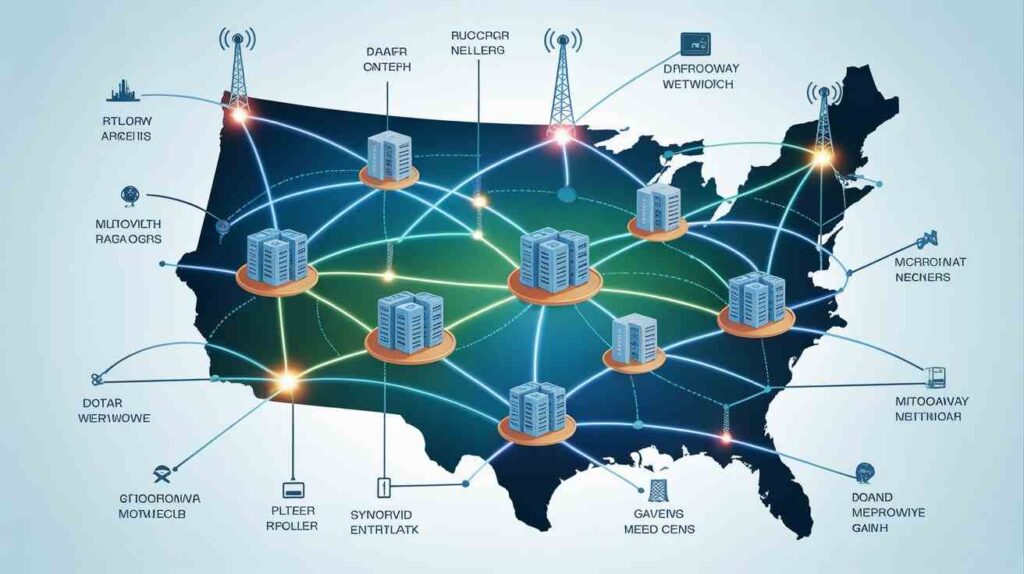
The architecture of a State Wide Area Network follows a hierarchical administrative connectivity pattern. The central network node at SHQ connects district administrative offices and grassroots administrative units. Vertical connectivity models ensure structured data routing optimization and consistent communication.
Meanwhile, horizontal connectivity allows functional units connectivity within each administrative level. Network distribution systems and high-capacity connectivity links enhance reliable communication infrastructure and scalable network architecture.
| Tier Level | Function | Connectivity Type |
| State Level | Centralized applications management | High-speed lines infrastructure |
| District Level | District administration management | Hybrid leased lines |
| Block Level | Citizen interaction | Satellite links connectivity |
Vertical Connectivity Across Administrative Levels
Vertical connectivity models connect SHQ to DHQ and BHQ through high-capacity links. This structured network design ensures consistent data flow management and reliable data exchange.
Horizontal Connectivity Between State Departments
Horizontal connectivity strengthens interdepartmental coordination. Departmental offices share data using centralized access systems and unified communication platforms.
Points of Presence and Network Distribution
Points of Presence support network distribution systems. These nodes improve data routing optimization and maintain operational integrity across state data center connectivity.
Bandwidth Planning and Scalability Framework
Bandwidth management ensures minimum bandwidth threshold standards such as 2 Mbps bandwidth, with scalability up to 1000 Mbps upgrades. Continuous network upgrades support scalable network expansion and fault tolerance systems.
Key Components of State Wide Area Network
The backbone communication network consists of core digital infrastructure elements. These include centralized data centers, network monitoring systems, and secure communication infrastructure. Government-operated networks rely on structured connectivity models for seamless connectivity.
Modern implementations also integrate AI tools integration and cloud platforms integration. These features support predictive analytics services, automated public services, and internet of things support for smart city applications.
State, District and Block Headquarters
The State Headquarters (SHQ) manages centralized applications and policy-level systems. District and block government offices rely on structured network design to ensure stable secure connectivity.
Core Routers, Switches and Firewalls
Network firewalls and access control systems protect sensitive data transport. These elements support cybersecurity management and data breach mitigation strategies.
Network Operations and Data Centres
State data centers handle centralized data management. Real-time monitoring systems and traffic logging systems maintain network uptime assurance and performance audits.
Advanced Security in State Wide Area Network
Security defines the strength of a State Wide Area Network. Encryption standards, role-based access control, and intrusion detection systems (IDS) protect government data security. Intrusion prevention systems (IPS) strengthen cyber threat protection and unauthorized access prevention.
Moreover, real-time coordination systems and monitoring mechanisms reduce security risk reduction. Continuous monitoring and authentication mechanisms maintain secure communication environments.
Closed User Group Access Framework
The Closed User Group (CUG) ensures restricted government access. It prevents exposure to public internet vulnerabilities and maintains a secure government network.
Encryption, Authentication and Role-Based Access
Encrypted communication channels protect sensitive government data. Authorization mechanisms and role-based authentication enhance data breach prevention.
Real-Time Monitoring and Threat Prevention
Real-time monitoring systems and traffic monitoring systems detect anomalies early. Cybersecurity protocols and operational limitations prevention strategies protect network integrity.
Disaster Recovery and Business Continuity
Redundant connectivity links and fault tolerance mechanisms support disaster response communication systems. These safeguards ensure uninterrupted connectivity and business continuity.
Benefits of State Wide Area Network
The State Wide Area Network strengthens governance efficiency enhancement. It enables administrative service delivery systems and reduces paperwork through manual process elimination. Digital audit trails enhance corruption reduction mechanisms.
Furthermore, the State Wide Area Network bridges the digital divide. Rural connectivity access supports local administration digitization. This ensures inclusive digital services and regional digital implementation.
Faster Administrative Decision Making Processes
Real-time data access and integrated databases allow faster decisions. Administrative coordination systems improve efficient coordination.
Improved Transparency and Accountability Systems
Digital audit trails and centralized access systems enhance transparency. Government transparency enhancement becomes measurable.
Cost-Effective Digital Governance Infrastructure
Dedicated managed reliability reduces high deployment costs over time. Investment in digital infrastructure improves long-term sustainability.
Enhanced Rural and Remote Connectivity
Satellite communication alternatives and radio link alternatives solve remote rural connectivity issues. Hybrid connectivity models ensure uninterrupted digital access across urban regions and rural areas.
State Wide Area Network vs Public Internet
A State Wide Area Network operates within a restricted ecosystem designed only for official administration. In contrast, the public internet connects millions of anonymous users through commercial service providers. While both enable connectivity, their intent differs sharply. One safeguards governance. The other supports general communication. This distinction shapes architecture, security, and accountability.
Unlike open internet traffic, a State Wide Area Network uses a controlled network environment. It relies on secure data transmission, encrypted communication channels, and centralized network management systems. The public internet cannot guarantee the same level of secure government connectivity or dedicated managed reliability.
Security and Privacy Comparison
Security begins with access control. A State Wide Area Network enforces role-based access control and authentication mechanisms. It deploys network firewalls, intrusion detection systems, and intrusion prevention systems. These measures reduce cyber threat exposure and support data breach prevention.
On the other hand, the public internet faces constant public internet vulnerabilities. Data moves through shared infrastructure. That increases security risk. Governments handling sensitive government data prefer isolated secure government networks for operational integrity.
Performance and Reliability Differences
Performance stability sets another difference. A State Wide Area Network ensures high network availability through dedicated bandwidth allocation and high-capacity connectivity links. It supports uninterrupted digital access even during heavy usage.
Public internet connections depend on variable traffic loads. Congestion can reduce speed and reliability. In contrast, structured network design within a State Wide Area Network guarantees stable secure connectivity and predictable network uptime assurance.
Control and Governance Advantages
Control defines governance power. A State Wide Area Network remains a government-owned communication network. Authorities manage policy-level systems, monitoring mechanisms, and operational standards directly.
Public internet services operate under commercial frameworks. Governments lack direct control over infrastructure decisions. Therefore, a State Wide Area Network offers stronger administrative hierarchy alignment and consistent policy implementation support.
Real State Wide Area Network Examples
Across regions, real implementations demonstrate how a State Wide Area Network strengthens governance. These deployments integrate administrative communication systems with centralized data centers. They support scalable network expansion and long-term infrastructure planning.
Each state adapts the model according to infrastructure readiness planning. Hybrid connectivity models combine leased lines connectivity with satellite communication alternatives to address remote rural connectivity issues.
Gujarat State Wide Area Network Model
The Gujarat State Wide Area Network stands as a benchmark example. Gujarat SWAN connects state-level departments through a hierarchical three-tier architecture. It integrates land record systems, treasury systems, and health information systems into one unified communication platform.
This model supports digital public services and real-time data access. Through centralized data management and state data center connectivity, Gujarat achieved governance efficiency enhancement and improved administrative workflow automation.
Tamil Nadu State Wide Area Network
Tamil Nadu SWAN emphasizes centralized applications management. It links district administrative offices with the state data center. High-speed lines infrastructure ensures seamless connectivity and digital service delivery infrastructure.
The network also supports online citizen portals and social welfare systems. Continuous network upgrades maintain long-term sustainability and operational limitations prevention.
North-East State Wide Area Networks
States such as Nagaland SWAN and Meghalaya SWAN adapted infrastructure for difficult terrain. They relied on hybrid leased lines and satellite links connectivity to overcome fiber access limitations.
Tripura SWAN expanded capacity using 1000 Mbps upgrades in high-demand areas. These models prove that a structured connectivity model can bridge digital divide challenges across geographically distributed offices.
Applications Powered by State Wide Area Network
A State Wide Area Network supports a wide ecosystem of government applications. It functions as the core digital infrastructure for administrative service delivery systems and integrated database connectivity.
From disaster response communication systems to financial management platforms, the backbone communication network ensures secure data exchange and uninterrupted connectivity across multiple government departments.
E-Governance and Digital Service Platforms
Digital governance programs rely heavily on a State Wide Area Network. It enables issuing certificates online, public portals access, and online service delivery systems. These digital service platforms reduce manual process elimination and strengthen citizen-government interaction.
By enabling electronic governance and centralized access systems, governments modernize public sector offices efficiently.
Financial, Health and Education Systems
Financial management systems and treasury platforms require secure data communication platforms. A State Wide Area Network protects encrypted data transmission across administrative tiers.
Similarly, health information systems and education information systems depend on integrated database connectivity. Secure transmission of official data supports reliable data connectivity and stable secure connectivity.
Integrated Command and Control Centres
Modern governance includes public safety systems and environmental monitoring systems. A State Wide Area Network enables real-time monitoring systems and predictive analytics services for rapid response.
Integration with Internet of Things support and smart city applications enhances disaster response coordination and operational integrity.
Challenges in Implementing State Wide Area Network
Despite its strengths, implementing a State Wide Area Network presents technical and operational challenges. Governments must address infrastructure readiness planning and skilled technical personnel requirements.
High deployment costs and maintenance expenditure require long-term sustainability strategies. Investment in digital infrastructure must align with governance strengthening frameworks.
Infrastructure and Bandwidth Limitations
Remote rural connectivity issues often arise due to electricity supply challenges and fiber access limitations. Governments rely on radio link alternatives and satellite communication alternatives to maintain uninterrupted connectivity.
Bandwidth management remains crucial. Maintaining minimum bandwidth threshold standards while planning scalable connectivity frameworks demands continuous monitoring.
Cybersecurity Risk Management Concerns
Cybersecurity management remains critical. Even within a secure communication environment, threats evolve. Governments deploy encryption protocols, authentication mechanisms, and intrusion prevention systems to protect sensitive government data.
Regular performance audits and monitoring mechanisms reduce data breach mitigation risks and strengthen operational integrity.
Skill Gaps and Operational Sustainability
Technical expertise development becomes essential. Network operation management requires trained personnel. Without adequate technical capacity building, structured digital governance infrastructure may suffer inefficiencies.
Sustaining scalable network architecture demands consistent training and administrative coordination systems.
Future of State Wide Area Network
The future of a State Wide Area Network aligns with comprehensive digital transformation goals. Governments increasingly connect with national digital initiatives to expand inter-state service delivery.
This evolution transforms the State Wide Area Network into a digital transformation foundation that supports automated public services and inclusive digital services.
Integration with National Digital Initiatives
Integration with the National e-Governance Plan and National Knowledge Network enhances global public sector connectivity. National network integration strengthens inter-government communication and digital governance alignment.
Cloud, AI and Smart Governance
Cloud platforms integration and AI tools integration unlock predictive analytics services. AI-enabled services improve policy implementation frameworks and administrative efficiency improvement.
Cloud-ready services and centralized data centers support scalable network expansion and fault tolerance systems.
5G, IoT and Edge Connectivity
5G technologies enhance high-speed connectivity. IoT deployments support smart city infrastructure and environmental monitoring systems. Mobile edge computing strengthens real-time coordination systems.
These advancements expand scalable connectivity frameworks for future governance models.
Final Thoughts on State Wide Area Network
A State Wide Area Network is no longer just a technical framework hidden behind government systems. It is the invisible engine that keeps modern governance running smoothly. From secure communication between departments to seamless online services for citizens, this infrastructure creates the stability and reliability that digital administration demands.
As governments expand digital services, improve transparency, and strengthen cybersecurity, the importance of a State Wide Area Network will continue to grow. It bridges urban and rural gaps, protects sensitive information, and supports mission-critical operations without interruption. In a world where data drives decisions and speed defines efficiency, a well-designed State Wide Area Network stands as the foundation of secure, accountable, and future-ready governance.
FAQs:
1. What is a State Wide Area Network (SWAN)?
A State Wide Area Network (SWAN) is a secure communication network that connects government offices and departments across a state, ensuring reliable data transfer and service delivery.
2. Why is SWAN important for governments?
SWAN enables secure, encrypted communication, supports e-governance, and improves operational efficiency by connecting multiple government departments seamlessly.
3. How does SWAN differ from the public internet?
Unlike the public internet, SWAN is a government-controlled network that provides enhanced security, dedicated bandwidth, and reliable connectivity for official use.
4. What are the benefits of SWAN?
SWAN improves administrative efficiency, strengthens security, supports digital governance, and reduces operational costs for government services.
5. What challenges are involved in implementing a SWAN?
Challenges include high deployment costs, bandwidth limitations, infrastructure readiness, and the need for skilled technical personnel to manage the network.
6. How does SWAN work?
SWAN works by connecting state departments through secure data channels, using encryption to ensure safe communication and data sharing across large areas.
7. What is the role of SWAN in e-governance?
SWAN supports e-governance by providing a reliable network for online services, real-time data access, and streamlined public service delivery.
8. What are the key components of SWAN?
The key components of SWAN include data centers, high-speed communication lines, routers, firewalls, and secure encrypted connections.
9. How does SWAN support rural connectivity?
SWAN uses satellite links and hybrid communication models to ensure that even remote areas can access secure government services.
10. What is the future of SWAN technology?
The future of SWAN includes integration with 5G, IoT, and AI to support faster, smarter, and more efficient government services.
ALSO READ
Choosing The Perfect World Of Warcraft Gaming Chair